
Origami Tobiichi
Origami Tobiichi |
|
|---|---|
 |
|
| Kanji | 鳶一 折紙 |
| Romaji | Tobiichi Origami |
| Statistics | |
| Species | Human Spirit (Formerly) |
| Gender | Female |
| Affiliations | Saito University Raizen High School (Formerly) Anti Spirit Team (Formerly) DEM Industries (Formerly) Ratatoskr |
| Occupation | University Student AST Wizard (Formerly) DEM Wizard (Formerly) |
| Rank | Master Sergeant (Formerly) B+ Rank Wizard (Formerly) AAA-Class Spirit (Spirit Form) SS-Class Spirit (Inverse Form) |
| Debut | |
| Anime | Episode 1 |
| Actors | |
| Japanese | Misuzu Togashi |
| English | Michelle Lee |
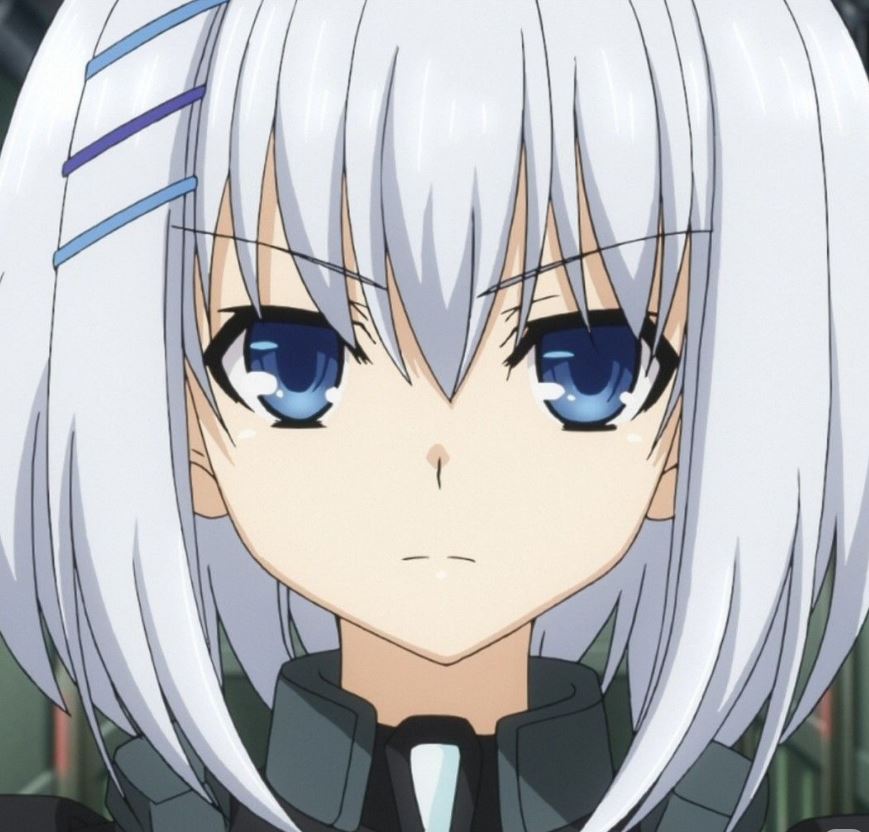
Origami Tobiichi (鳶一 折紙, Tobiichi Origami) is one of the main female protagonists of the Date A Live series. A classmate of Shido Itsuka, she is widely recognized at Raizen High School for her exceptional academic performance, athletic ability, and striking beauty. Outside of her school life, she serves as a Wizard of the Anti-Spirit Team (AST), driven by a personal mission to avenge her parents by eliminating Spirits. Over the course of the series, she later becomes the eighth Spirit to manifest.
Appearance
Appearance in her AST Wiring Suit
Origami is depicted as a young, attractive woman with short, silvery-white hair styled in a bob cut, accented by three hair clips on the right side, and striking blue eyes. Her delicate facial features are often likened to those of a porcelain doll, noted for both their beauty and her frequent lack of expression. After becoming a Spirit, her eye color shifts from blue to a pale light blue with white accents. In the altered timeline, she initially appears with waist-length hair before cutting it back to its signature short style following the sealing of her Spirit powers. While attending Raizen High School, she wears the school’s female uniform, and by her university years, her hair is shown to have grown to shoulder length. She stands at 152 cm, with measurements recorded as B75/W55/H79.
When dressed in her AST Wiring Suit, Origami presents a more combat-oriented appearance. She forgoes her hair clips in favor of attached sensor units, and wears armor plating from her shoulders to her hands, as well as along parts of her torso and legs, leaving her thighs exposed. The upper portion of the suit’s transparent material reveals her chest and midriff. When operating her DEM CR-Unit Mordred, she dons dark grey armor with X-shaped thrusters mounted on her back, visually echoing the design of Ellen Mathers’ CR-Unit Pendragon.
Origami’s Astral Dress resembles a wedding gown, symbolizing her childhood dream of becoming a beautiful bride. The ensemble is described as angelic from a distance and features a golden crown with an attached white veil, a white bow and gem at the neck, and gold-plated extensions on her hips and forearms. The skirt’s edges fold like flower petals, with gold-tipped ends, and she wears a glistening ring on the fourth finger of her left hand. When her Limited Astral Dress is combined with the Ratatoskr CR-Unit Brunhild, she retains the gown’s veil and skirt while gaining additional gold-and-white armor plating.
In her Inverse Form, Origami’s attire transforms into a dark blue mourning dress with a more revealing cut. She wears a large veil draped over her head, and jagged markings appear across her exposed torso and thighs.
Personality
In the original timeline, Origami is generally quiet and unsociable, rarely initiating conversation unless necessary, with exceptions for individuals such as Shido Itsuka and Tohka Yatogami. She is not shy but speaks with a blunt and direct tone, often disregarding social norms openly displaying her attraction to Shido even in public.
Origami is highly goal-driven and willing to take extreme measures to achieve her objectives, sometimes acting recklessly or aggressively. This determination is demonstrated when she complied with all of Shido’s attempts to discourage her, shocking those around them. Her intense hatred for Spirits stems from the death of her parents at the hands of one five years earlier. Upon encountering a Spirit, she would lose her composure and relentlessly attempt to eliminate it, viewing such actions as both revenge and a means of protecting others from similar loss. Her hostility was so strong that she attempted to kill Kotori Itsuka despite knowing she was Shido’s sister, stopping only when her CR-Unit reached its time limit, Shido intervened, and she learned of Phantom’s existence.
Over time, her desire for greater strength led her to join DEM Industries. After being defeated, she accepted a Sephira Crystal that transformed her into a Spirit, an existence she despised. Though disgusted by her new identity, she took satisfaction in finally being able to fight Spirits on equal terms. She resolved to become the “Spirit that kills Spirits” before ending her own life, but fled from Shido immediately after her transformation, ashamed and unable to face him.
Upon discovering the truth of her parents’ deaths, Origami suffered an emotional collapse and Inverted. In this state, she became completely unresponsive, described by Kurumi Tokisaki as being in an irrecoverable condition. Even in the altered timeline, this version of Origami persisted, retaining all her memories. After eventually confronting her emotional pain, she regained stability, allowing the old timeline personality to become dominant. She cut her hair short again, abandoned her grudge against Spirits, and reclaimed the emotions she had entrusted to Shido years earlier. Admitting genuine love for him, she refused to yield to Tohka, though she remained blunt and occasionally displayed obsessive tendencies. A year after the Spirits’ disappearance, she appeared noticeably more cheerful, smiling and joking more frequently.
In the new timeline created when Shido prevented the Spirit version of Origami from killing her parents Origami never became an avenger, resulting in a more cheerful and approachable personality. She occasionally questioned the AST’s mission to kill Spirits and displayed a shyer, more conventional demeanor when interacting with Shido, especially when he invited her on a date. Shido observed that her clothing choices and behavior were more feminine than her old self’s, likely reflecting how she might have been prior to her parents’ deaths. Unaware that she possessed Spirit powers inherited from the old timeline, she initially lived without knowledge of her supernatural side.
The old timeline’s Origami continued to exist within her, though suppressed to maintain her sanity. This suppressed self would occasionally manifest, particularly during her date with Shido, exhibiting perverted or stalker-like tendencies that left the new Origami confused and embarrassed. When sensing Reiryoku, her original hatred for Spirits would resurface, triggering her Inverse transformation. Eventually, the two personalities met and fused, enabling Shido to save her from her catatonic state. It was revealed that the old Origami’s feelings for Shido had been based on emotional dependence, whereas the new Origami genuinely fell in love with him during their date.
In Itsuka Disaster, it is suggested that after being sealed, the personalities of both timelines merged, though the old timeline’s persona became dominant. The new personality remains dormant but can surface in certain situations, such as during the Spirit battle royal finale and when Mukuro Hoshimiya sealed Shido’s memories from the other self. The new Origami often appears in everyday scenarios or when privately panicking over her behavior toward Shido, worrying about how he perceives her.
In this timeline, Origami also engages in internal “debates” represented by an Angel and a Devil, visual manifestations of her two selves. Ironically, the Devil (depicted with her long-haired appearance from the new timeline) is the rational voice, while the Angel (shown with her short-haired old timeline look) encourages her to follow her impulses. These mental exchanges frequently distract her from reality and may explain some of her erratic actions.
Background
Before the events of the series, Origami lived an ordinary life. In school, she excelled in mathematics but struggled with Japanese language studies. Her favorite food was gratin, while she disliked celery, and her childhood dream was to become a “cute bride.”
Five years prior to the main story, Origami’s life changed drastically. Returning home one day, she found her neighborhood engulfed in flames. Relieved to find her parents safe, she was suddenly struck by tragedy when a beam of radiant light descended from above, killing them instantly and creating a shockwave that threw her back. Looking skyward, she saw what she could only describe as an “angel,” and vowed to one day destroy the Spirit responsible.
She was soon approached and comforted by Shido Itsuka though unknown to her, he had traveled back from five years in the future using Zafkiel and had been transformed into a child by Haniel. Shido’s words encouraged her, but also caused her to develop emotional dependence on him. From that day, she entrusted him with her tears and smile, vowing never to show either until she had avenged her parents.
Determined to gain the strength to achieve her goal, Origami devoted herself to excelling academically and physically, abandoning personal likes and dislikes, including her food preferences, in favor of a strict regimen to optimize her health. She was later taken in by a nearby aunt, a former member of the Anti-Spirit Team (AST), who introduced her to the existence of Spirits. Through her aunt’s connections and her compatibility with the Realizer technology, Origami was recruited into the AST.
The events of the past were altered when Shido used Kurumi Tokisaki’s Twelfth Bullet, Yud Bet, twice to travel five years into the past. In this revised history, Shido prevented the Spirit from killing Origami’s parents, taking the deadly blast himself. Witnessing what appeared to be his sacrifice instilled in her a vow never to let someone else die for her again. She resolved to be the one protecting others, joining the AST not out of revenge, but to safeguard lives.
Tragically, a year later, her parents died in a traffic accident. At some point afterward, the Spirit powers and memories of the old timeline’s Origami were transferred to her. To preserve her sanity, her mind developed a split personality: the new timeline Origami remained in control during normal circumstances, while the old timeline Origami became dominant whenever she entered her Inverse Form. This form would trigger upon sensing Reiryoku, compelling her to attack the Spirit associated with it.
Unaware of the true cause, both Origami and the AST believed these blackouts to be unexplained episodes. Her frequent Inverse transformations during AST missions, combined with her growing doubts about whether Spirits were inherently evil, eventually led Origami to resign from the AST. Following her departure, she transferred to Raizen High School shortly after Shido’s return to the new timeline.
Relationships
Shido Itsuka
Due to Shido’s time travel using Kurumi Tokisaki’s Zafkiel, Origami became aware of him years before their official meeting. She is determined to become his lover and frequently seizes opportunities to deepen their relationship, often through direct and unconventional methods of seduction. Despite her blunt approach, she places considerable trust in him, complying with most of his requests and showing genuine concern for his well-being. Her strong fixation on Shido manifests in her stalking habits, which have led her to compile detailed personal records on him, ranging from identification documents to medical reports.
Tohka Yatogami
Origami initially viewed Tohka as both a hostile Spirit and a romantic rival, often referring to her dismissively as an “idiot” who obstructed her interactions with Shido. Their antagonism was fueled by Origami’s role in the Anti-Spirit Team (AST) and the unresolved tension between them, even after Tohka’s powers were sealed. Origami attempted to formally report Tohka’s identity as the Spirit Princess, but Ratatoskr’s extensive cover story and Tohka’s sealed status forced Origami into an uneasy, non-hostile coexistence with her.
Kotori Itsuka
Origami regarded Kotori as a future sister-in-law through her connection to Shido. However, upon witnessing Kotori’s Spirit form in Volume 4, she immediately attempted to kill her using forbidden technology, under the mistaken belief that Kotori was the Spirit responsible for her parents’ deaths. In Volume 12, Origami grew suspicious of Kotori’s unusual behavior and followed her, threatening her once again while interrogating her about an alleged plan to kill Shido. Despite her hostility, Origami showed empathy when Kotori broke down in tears, acknowledging her as a good sister after Kotori made a self-deprecating remark.
Yoshino Himekawa
Despite Yoshino’s gentle and nonviolent nature, Origami pursued her relentlessly as a Spirit, even attempting to crush her with debris while she hid inside her blizzard dome. After Yoshino was sealed, Origami continued to tease her, once claiming that swimsuits were anti-Spirit weapons. Her attitude toward Yoshino softened somewhat after Origami’s own Spirit powers were sealed. During the battle royal, Origami classified Yoshino as a mid-range threat due to her strong defensive abilities. This assessment backfired when Yoshino, taking advantage of Origami’s exhaustion, defeated her and claimed victory in the competition.
Etymology
Origami’s given name, 折紙 (Origami), is written with the kanji 折 (ori), meaning “to fold” or “break,” and 紙 (gami/kami), meaning “paper.” The name directly references the traditional Japanese art of paper folding, which may symbolize precision, complexity, and the ability to transform something simple into something intricate qualities reflected in her strategic combat skills and adaptability.
Her family name, 鳶一 (Tobiichi), combines 鳶 (tobi), meaning “kite” or “black kite” (a type of bird of prey), and 一 (ichi), meaning “one” or “first.” This could imply a lone, soaring figure, possibly alluding to her independent and determined nature.
Origami’s Astral Dress, which resembles a wedding gown, connects symbolically to her childhood dream of becoming a bride, while the color white in her design may represent purity or her original ideals before being shaped by tragedy.