
Jusaburō Mōri
Jusaburō Mōri |
|
|---|---|
 |
|
| Kanji | 毛利寿三郎 |
| Rōmaji | Mōri Juzaburō |
| Nicknames | Super High School Doubles Specialists Fairy Senpai (by Yukimura Seiichi) |
| Personal Information | |
| Junior High | Rikkaidai -presumed (1st Year) |
| Club Position | Regular |
| Gender | Male |
| Dominant Arm | Right |
| Japan U-17 Camp | No.10 of All Japan Representative (re-instated) |
| Doubles Partner(s) | Ochi Tsukimitsu Renji Yanagi |
| Play Style | All Rounder |
| Racquet(s) | Dunlop Biomimetic M3.0 |
| Shoes | Dunlop Hybrid Pro II |
| Debut | |
| Manga |
|
| Anime |
|
| Portrayal | |
| Japanese Voice |
|
Personality
Appearance in Anime
Mōri Juzaburō is initially portrayed as somewhat arrogant, much like many of the Genius 10 players, often looking down upon those outside the Top 10 lineup at the U-17 camp. He exudes an air of confidence and nonchalance, making him seem detached from those around him. However, despite his seemingly dismissive attitude, Mōri possesses a deep understanding of the game and a hidden sense of responsibility toward his teammates.
His relationship with his former Rikkai teammates, particularly Yukimura Seiichi, Sanada Genichirō, and Yanagi Renji, is initially strained. He criticizes them as being arrogant and expresses a desire to challenge them again. Yanagi, in particular, harbors resentment toward Mōri for skipping practice during their time at Rikkai. This behavior frustrated Yanagi, especially because Yukimura was battling his illness and working tirelessly to recover while Mōri appeared indifferent. Due to Mōri’s frequent absences, Yanagi was also unable to collect much data on him, adding to his frustration.
However, Mōri underwent significant personal growth after leaving Rikkai. Shortly after entering high school, he suffered a leg injury and, while leaving the hospital, witnessed Yukimura’s intense rehabilitation process. Seeing Yukimura’s relentless fight against his body’s limitations inspired Mōri to change his ways. Determined to take tennis more seriously, he began practicing rigorously, pushing himself to the limits of physical endurance. His efforts paid off when he won a major tournament, earning an invitation to the U-17 Training Camp. Despite his past attitude, Mōri secretly cared for his former teammates, even leaving fresh water bottles in Yukimura’s room each night during his hospital stay and observing Rikkai’s matches to study their playing styles. During Japan’s match against France, Mōri even provided Yanagi with strategic advice, which played a key role in securing their victory.
On the court, Mōri is calm, collected, and highly adaptable. His confidence allows him to analyze opponents’ techniques quickly, as seen during his doubles match against Niō Masaharu and Atobe Keigo when he effortlessly returned the Zero Shiki Serve after observing it a few times. He maintains a playful demeanor while playing, often taunting and teasing his opponents, though this never undermines his focus.
Despite his carefree attitude, Mōri holds great respect for Ochi Tsukimitsu, his doubles partner, and follows his instructions without hesitation. Their strong teamwork and complementary playstyles make them a formidable duo on the court.
Appearance
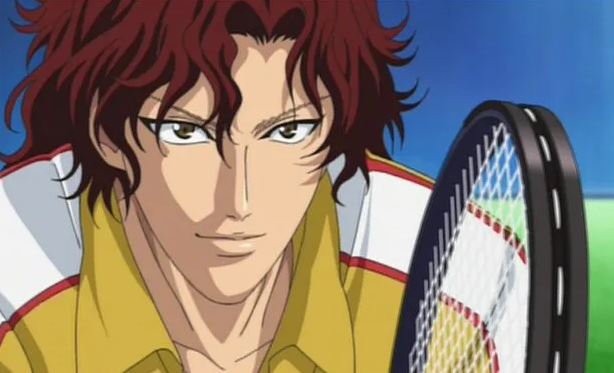
Mōri Juzaburō is tall and lean, standing at 191 cm (6’3″), making him one of the taller players at the U-17 camp. His most distinguishing feature is his long, wavy, shoulder-length brown hair, which gives him a laid-back and somewhat carefree appearance. Despite his relaxed demeanor, his sharp eyes and confident expression hint at the hidden strength and strategic mind that make him a formidable tennis player. Like the other high schoolers, Mōri carries himself with a natural air of authority, but his casual posture and subtle smirks often reflect his playful personality on and off the court.
Background
Mōri Juzaburō is a first-year high school student and a former regular of the Rikkai Dai Fuzoku tennis team. He was part of the national championship-winning team a year before the events of New Prince of Tennis. Despite his natural talent, Mōri was known for frequently skipping practice, a habit that frustrated his teammates, particularly Yanagi Renji, who struggled to collect data on him. His laid-back attitude set him apart from the other serious Rikkai players like Yukimura Seiichi and Sanada Genichirō, who dedicated themselves fully to tennis.
However, after losing a match early in his high school career and suffering a leg injury, Mōri experienced a turning point. While recovering in the hospital, he witnessed Yukimura’s grueling rehabilitation process as he fought to regain his ability to play. Inspired by Yukimura’s unwavering determination, Mōri decided to change his approach to tennis. He began practicing intensely, pushing himself to his limits, and ultimately won a major tournament, earning an invitation to Japan’s U-17 Training Camp.
Now a member of the U-17 All-Japan Team, Mōri is ranked No.10 among Japan’s top juniors, forming a powerful doubles duo with Ochi Tsukimitsu, the former captain of Hyotei Academy, who ranks No.9. Together, they are recognized as Japan’s elite high school doubles specialists, feared for their unpredictable playstyle and high-level synergy on the court.
History
Mōri Juzaburō was a member of Rikkai Dai’s championship-winning team that went undefeated throughout the year, dominating all tournaments, including the National Tournament. Alongside his formidable teammates Yukimura Seiichi, Sanada Genichirō, Yanagi Renji, Yagyū Hiroshi, and others, Mōri contributed to Rikkai Dai’s complete dominance. In the Nationals Semifinals, Rikkai swept Shitenhōji in straight sets, and Mōri defeated Oshitari Kenya in a Singles match, a game that Chitose Senri later described as a complete wipeout. This match was also briefly shown in the New Prince of Tennis OVA Episode 3.
Mōri was introduced at the U-17 Camp as one of the Top 10 All-Japan Juniors, ranked No.10, while the camp was undergoing a major revolution. As the 1st Stringers battled the middle schoolers for survival in the camp, Mōri and the rest of the Top 10 players waited for the results. However, to their shock, several of the 1st String players (No.11-19) were replaced by middle schoolers.
That night, Mōri trained alongside his doubles partner, former Hyotei Academy captain Ochi Tsukimitsu, in preparation for their upcoming matches. He also expressed excitement at the possibility of playing against his former Rikkai teammates Yukimura, Sanada, and Yanagi whom he viewed as arrogant rivals.
The next day, Mōri and Ochi (No.9) were challenged for their positions by Atobe Keigo and Niō Masaharu. However, Mōri was stunned when Niō used his Illusion technique, impersonating Tezuka Kunimitsu, making the middle schoolers a formidable team.
The match started with Ochi’s powerful Mach Serve dominating the first game, but Niō retaliated by using Tezuka’s Zero Shiki Serve and secured a game for their side. The two pairs played evenly, but the high schoolers maintained a slight edge. Atobe and Niō struggled for more power, prompting Niō to transform into Kabaji, which increased their strength significantly.
At a crucial moment, Ochi unleashed his Mental Pressure ability, causing Atobe to double fault several times and allowing the high schoolers to level the score at 6-6. During the tiebreak, Kabaji who had been watching intervened by returning a shot to protect Atobe, which resulted in his disqualification from the camp. Despite Atobe being touched by Kabaji’s sacrifice, he harshly dismissed him, not wanting to show weakness.
Ochi and Mōri initially dominated the second set, overwhelming Atobe, who was essentially playing alone. However, in a dramatic twist, Niō transformed into Atobe himself, allowing them to activate Synchro. With enhanced vision and coordination, Atobe fought back, eventually winning the third set 7-6. As a result, Niō took Mōri’s No.10 position, but was immediately hospitalized due to exhaustion, leading to Mōri being reinstated as No.10.
Mōri and the Japan U-17 team participated in a beach challenge, where players had to pick up girls as part of a social training exercise. Those who failed had to consume Mitsuya’s Inui-Juice-filled rice balls. Surprisingly, Mōri voluntarily tried one—only to pass out immediately.
Mōri was selected to play in the U-17 World Cup Quarter-Finals against France. He was paired with his former Rikkai teammate, Yanagi Renji, in Doubles 1, facing Jonathan Saint-Georges and Edgard Delacroix.
However, Yanagi harbored resentment toward Mōri for skipping practice back in Rikkai and for seemingly ignoring Yukimura’s hospitalization. Their dysfunctional teamwork resulted in an ineffective performance, giving France an early lead.
During the match, Yanagi realized that Mōri had been the one secretly leaving sports drinks in Yukimura’s hospital room every night, motivating him to recover. Upon learning this, Yanagi reconciled with Mōri, and the two began working together.
To counter their opponents, Mōri entered his “Sleeping State”, playing effortlessly while appearing unconscious. This confused Jonathan, who failed to analyze Mōri’s movements, leading to a shocking turnaround. Yanagi, with his data analysis, successfully countered their opponents’ strategy. Eventually, Mōri and Yanagi secured the victory for Japan, eliminating France from the tournament.
Before the U-17 World Cup Finals, the Japan U-17 team held an intra-ranking tournament to determine the final roster against Spain. Mōri partnered with Ochi Tsukimitsu once again, playing as Doubles 1.
In the first round, they faced Kimijima Ikuto and Atsukyo Tōno, winning a close match. During the battle, Ochi awakened his true potential, revealing that he was actually Japan’s former No.4 player.
In the final round, they were set to face the “Masked Men”, who were widely suspected to be Jujiro Oni and Hōō Byōdōin, two of Japan’s most powerful players. The outcome of this match would determine their standing in the final showdown against Spain.
Tennis Skills and Playstyle
Mōri is known as a “Doubles Master,” excelling in strategic teamwork and court awareness. However, his singles skills are just as impressive, and his ability to disguise his true strength makes him an unpredictable opponent. His techniques emphasize control, deception, and adaptability, allowing him to manipulate the flow of the game while appearing effortless.
Some of his notable skills include:
Hidden Strength
Mōri appears to play casually and with minimal effort, but he rapidly shifts gears when necessary, shocking opponents with unexpected bursts of power and skill.
Doubles Expertise
His court positioning, coordination, and teamwork make him a master of doubles play, allowing him to outmaneuver opponents with ease.
Instinctive Play
Rather than relying on rigid strategy, Mōri’s natural talent and instinctive decision-making allow him to react effortlessly to any situation.
Mental Warfare
By downplaying his abilities, he lulls opponents into a false sense of security, only to overwhelm them when the time is right.
Etymology
The name Juzaburō (寿三郎) carries several meaningful elements in Japanese kanji, “Ju” (寿) – Meaning “longevity, congratulations, or one’s natural life,” which can symbolize endurance, resilience, or a long and prosperous life. “Sabu” (三) – Meaning “three,” possibly referring to a generational or ranking significance. “Rō” (郎) – Meaning “son,” which is a common suffix in traditional Japanese male names, often denoting youth or noble birth.
His surname Mōri (毛利) also holds distinct meanings, “Mō” (毛) – Meaning “hair or fur,” which could metaphorically represent softness, adaptability, or something natural and unrestrained. “Ri” (利) – Meaning “benefit or advantage,” suggesting skill, intelligence, or an advantageous position in life or competition.