
Junko Enoshima
Junko Enoshima |
|
|---|---|
 |
|
| Kanji | 江ノ島 盾子 |
| Romaji | Enoshima Junko |
| Katakana | エノシマ ジュンコ |
| Personal Information | |
| Gender | Female |
| Birth Date | December 24 |
| Participated in | The Tragedy of Hope’s Peak Academy Killing School Life |
| Affiliation | Ultimate Despair (originator and founder) |
| Previous Affiliation | Gunma Prefectural Shibutani High School Hope’s Peak Academy Class 78th |
| Debuts | |
| Anime | Danganronpa: The Animation |
| Manga | Danganronpa: The Manga |
| Portrayal | |
| Japanese Voice | Megumi Toyoguchi |
| English Voice | Jamie Marchi |
Appearance
Appearance in Anime
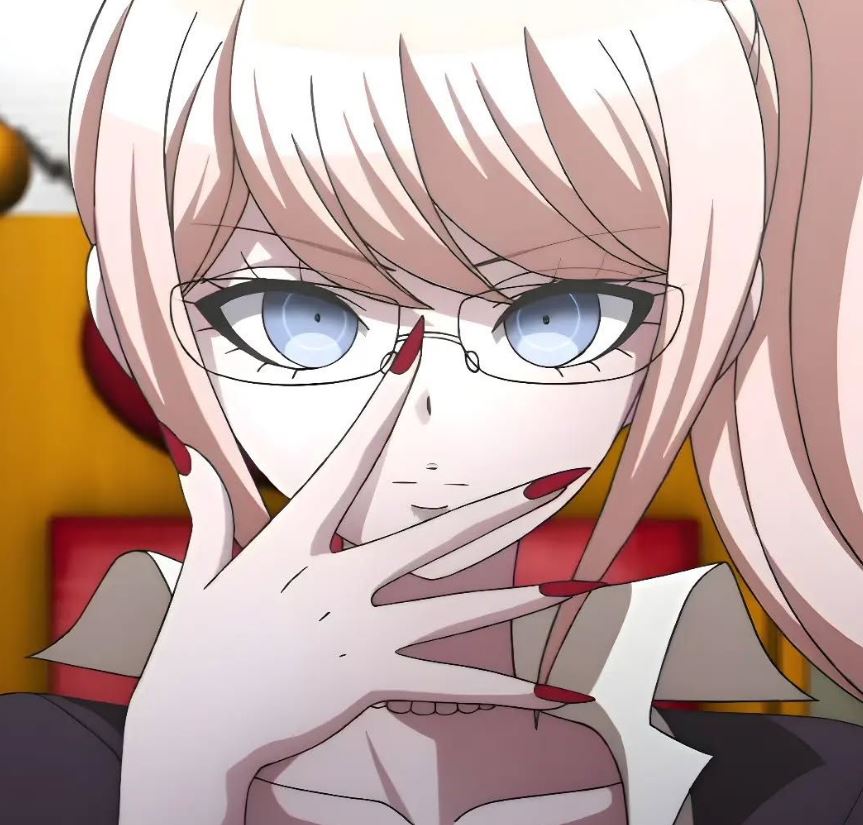
At the beginning of the Killing School Life in Danganronpa: Trigger Happy Havoc, Junko appears to be a young high school-aged teenager. However, due to the memory loss inflicted upon her and her classmates, she is actually two years older than she believes. Junko is noted for her tall, striking hourglass figure, long bleached strawberry-blonde hair worn in thick twin pigtails, and vivid light-blue eyes though at times she is shown to have natural red eyes. She wears heavy makeup, paired with painted red nails, reinforcing her public image as the Ultimate Fashionista.
Junko and her older twin sister, Mukuro Ikusaba, share many physical traits, though Junko’s features are more exaggerated. She has a fuller chest, larger eyes, and lacks Mukuro’s freckles. The two differ further through their eye colors, with Mukuro’s being light purple compared to Junko’s blue or naturally red.
Her standard outfit includes a black cardigan worn loosely over a white dress shirt, left unbuttoned to reveal the top of her black-and-red bra. She pairs this with a very short red pleated skirt, a loosely tied long necktie (alternating between a half-black, half-white design with a prohibition sign in Trigger Happy Havoc and pure white in Danganronpa 3), a small black choker, and a red bow pinned above her left breast. Her footwear consists of platform-heeled black boots laced in red. Her most iconic accessories are her twin bear hair clips, styled after Monokuma: the right clip is a plain white bear, while the left is a black bear with jagged red eyes and a sinister grin.
Junko also has a number of alternate outfits across different entries. In Danganronpa 3: The End of Hope’s Peak High School, she briefly dons a flashy cheetah-print dress with a fur-trimmed collar and cuffs, dark sunglasses, a wide belt, and heels. During her time at Hope’s Peak Academy (before the Killing School Life), she is seen in the school uniform, consisting of a white shirt, navy pleated skirt, and cardigan, accessorized with bunny- and bow-shaped hair clips in place of her Monokuma ones.
In Danganronpa Zero, Junko is described as looking far more average without makeup. Her alternate identity, Ryoko Otonashi, has long, unkempt dark red hair and red eyes, a stark contrast to her glamorous model persona. Flashbacks in Danganronpa Another Episode: Ultra Despair Girls and Zero further show her experimenting with different variations of her Hope’s Peak attire, always maintaining her signature dramatic style.
Personality
At first glance, Junko Enoshima presents herself as a charismatic fashionista—talkative, carefree, and slightly hot-tempered. She initially appears somewhat air-headed, but her charm and energy make her stand out. The official artbook describes her as someone who “drips with dissatisfaction the moment she opens her mouth,” often finding herself at odds with her classmates due to her excessive bluntness and restless nature.
Her true personality, revealed at the climax of the Killing School Life, is far more disturbing. Junko is profoundly apathetic and suffers from an abnormal intolerance for boredom. To combat her own restlessness, she constantly shifts between multiple fabricated personas, each with its own speech patterns, mannerisms, and tone of voice. These range from exaggerated cuteness, clinical seriousness, regal superiority, and vulgar playfulness to flat monotone stoicism, deep depression, or even mimicking Monokuma himself. This instability makes her highly unsettling to interact with, as she frequently changes roles mid-conversation.
At her core, Junko is completely consumed by despair. She finds despair to be the only genuine form of stimulation, whether inflicted upon others or experienced herself. This obsession drives her to orchestrate suffering on a massive scale, wishing to plunge the entire world into hopelessness. However, her fixation on despair also serves as her greatest weakness: she deliberately gives her opponents opportunities to resist, as their inevitable defeat makes their despair more profound. Similarly, she embraces her own failures, welcoming them as another form of despair to savor.
Junko’s actions are not guided by ideology or ambition but rather by despair for despair’s sake, making her unpredictable and impossible to reason with. Even so, supplementary material and the anime suggest that her extraordinary analytical abilities may have contributed to her descent. She grew resentful of Hope’s Peak Academy’s glorification of talent as “hope” and sought to corrupt this ideal, transforming talent into a tool of despair. Interestingly, under amnesia, Junko shows no particular desire for despair or rejection of boredom, suggesting her obsession stems directly from her memories and her fixation on despair as her ultimate worldview.
As the mastermind and leader of Ultimate Despair, Junko proves herself to be manipulative, cunning, and cruel. She has no hesitation in using physical and emotional abuse to control others, often exploiting their insecurities, desires, and weaknesses. While she detests hope, peace, and happiness, she sometimes deliberately grants hope to others only to cruelly tear it away, amplifying their suffering. Her manipulations allow her to avoid direct responsibility, instead blaming her victims to “prove” that despair lies inherently within everyone.
Despite her ruthlessness, Junko demonstrates that she is capable of love, though it is warped by her devotion to despair. She inevitably destroys those she cares for, deliberately killing or betraying them in order to experience the despair of losing someone precious.
According to series creator Kazutaka Kodaka and Junko’s voice actress, her portrayal in Danganronpa 3: Despair Arc is closer to her natural personality, still sharp and cynical, but more neutral and stable than the chaotic persona-switching seen in the first game. This suggests that her instability during Trigger Happy Havoc was the result of her deepening descent into despair and declining mental health. Even the global tragedy she engineered, which appeared chaotic and catastrophic, ultimately unfolded exactly as she had planned, leaving her unsatisfied as despair itself became predictable.
Background
Junko Enoshima was scouted by Hope’s Peak Academy as the Ultimate Fashionista, gaining fame as a charismatic model prior to her enrollment. Her striking looks and sense of style made her a well-known celebrity, though much of her public image was fabricated. In truth, Junko found the world of fashion shallow and unfulfilling, using her career only as a tool to gather influence and recognition.
Behind the persona of the glamorous fashionista, Junko had already begun cultivating her darker philosophy. Possessing extraordinary analytical abilities, she developed a worldview centered on despair as the ultimate experience of human emotion. Dissatisfied by ordinary life and frustrated by the glorification of “hope” through talent, she resolved to corrupt the very ideals Hope’s Peak sought to uphold.
Junko was born as the younger twin sister of Mukuro Ikusaba. Despite sharing a close bond in childhood, Junko often manipulated and belittled Mukuro, exploiting her loyalty. While Mukuro admired Junko deeply and obeyed her every command, Junko viewed her primarily as a pawn in her grand designs. Together, they infiltrated Hope’s Peak Academy, Junko under her Ultimate Fashionista identity and Mukuro in disguise. Junko’s true talent, however, was not fashion but her analytical genius, which allowed her to manipulate situations and people to devastating effect.
During her time at Hope’s Peak, Junko abandoned her original title and rebranded herself as the Ultimate Analyst, though this truth was concealed from her classmates. Her talent allowed her to accurately predict outcomes and manipulate events with precision. It was this ability that ultimately steered her toward despair, as she found no challenge or unpredictability in hope or happiness.
Junko’s growing obsession culminated in her orchestrating the Tragedy of Hope’s Peak Academy. Alongside Mukuro, she initiated the Killing School Life, manipulating Monokuma to act as her proxy and forcing Class 78 into a deadly mutual killing game. Her plan was not only to destroy her classmates but also to broadcast their suffering as part of a larger campaign to plunge the world into chaos. This event became the spark for the wider The Tragedy, a catastrophic global conflict fueled by despair.
Despite her manipulative control and meticulous planning, Junko’s downfall came during the final class trial of Danganronpa: Trigger Happy Havoc. After her role as the mastermind was exposed by Makoto Naegi and the surviving students, she accepted her defeat not with fear but with exhilaration, embracing the despair of her own execution. For Junko, death itself was the ultimate form of despair and she welcomed it wholeheartedly, ensuring her legacy as the central figure behind the rise of Ultimate Despair.
Talents and Abilities
Ultimate Fashionista
Junko’s publicly recognized title, the Ultimate Fashionista, reflects her success as a popular model and fashion icon. She frequently appeared on magazine covers and gained widespread attention for her style, charisma, and trendsetting image. However, much of her fame was a carefully crafted façade. Using her analytical talent, she could predict upcoming fashion and cultural trends with near-perfect accuracy, allowing her to simulate the appearance of a natural fashion prodigy.
Super High School Level Gyaru
In the original Japanese, Junko’s title is Super High School Level Gyaru (超高校級の「ギャル」). The term gyaru refers to a Japanese fashion subculture characterized by bleached or dyed hair, elaborate nail art, bold makeup, and altered school uniforms. As a high schooler, Junko specifically fit the kogyaru category, known for short skirts, platform boots, and accessorizing personal items such as cell phones. Her courtroom avatar in Danganronpa 2, an overly decorated phone—references this culture directly. Her distinctive strawberry-blonde hair and blue eyes are implied to be artificial, suggesting her natural appearance may have been closer to her alternate persona, Ryoko Otonashi, who had darker red hair and eyes.
Super High School Level Analytical Prowess
Junko’s true talent, hidden behind her public fashion image, is her near-superhuman analytical ability. She can absorb, process, and recall information with extreme precision, allowing her to master new skills after minimal exposure. With this ability, she:
This ability also made her the true force behind the Tragedy of Hope’s Peak Academy, as she could predict human behavior, manipulate social movements, and guide events toward global despair. Her capacity to anticipate outcomes, while invaluable for manipulation, also drove her into boredom, pushing her to embrace despair as the only true unknown.
Ultimate Despair
Junko’s obsession with despair culminated in her becoming the embodiment of the title Ultimate Despair. She could exploit weaknesses, manipulate individuals into destructive choices, and spread despair on both personal and massive scales. Through her influence:
While she succeeded in breaking countless individuals, she failed to corrupt Makoto Naegi, whose unwavering optimism positioned him as the mirror opposite to her own role, Ultimate Hope.
Ability to Sense Talent, Hope, and Despair
Beyond her analytical genius, Junko appeared to have an intuitive sense for identifying hope and despair in others. In Danganronpa Zero, even as her amnesiac persona Ryoko Otonashi, she could detect Makoto Naegi’s latent potential. Similarly, in Danganronpa 3, she immediately recognized the power within Ryota Mitarai’s unique talent. This mysterious perception paralleled Nagito Komaeda’s ability to sense hope and despair, setting Junko apart as someone instinctively drawn to those who could shape the balance between the two forces.
Etymology
Junko (純子 / 潤子 / 順子, etc.) is a common Japanese feminine given name, and depending on the kanji, it can have several meanings, such as “pure child” (純子), “obedient child” (順子), or “moist/beneficial child” (潤子). In Junko’s case, the name contrasts heavily with her true nature, as her obsession with despair makes her the opposite of “pure” or “obedient.”
Enoshima (江ノ島) refers to a small offshore island in Kanagawa Prefecture, a popular tourist destination in Japan. Using it as her surname may symbolize a constructed, artificial identity, much like how Junko presents herself with false talents and personas.
Her nickname “Ultimate Despair” (超高校級の「絶望」, Chō-kōkō-kyū no “Zetsubō”) directly positions her as the antithesis to Ultimate Hope, a title embodied by Makoto Naegi.