
Haruka Saigusa
Haruka Saigusa |
|
|---|---|
 |
|
| Kanji | 三枝 葉留佳 |
| Romaji | Saigusa Haruka |
| Statistics | |
| Birthday | October 13 |
| Gender | Female |
| Occupation | Student |
| Position | Eighth Little Busters Member Maintenance Committee Member |
| Debut | |
| Anime | Episode 3 |
| Actors | |
| Japanese | Keiko Suzuki |
| English | Margaret McDonald |
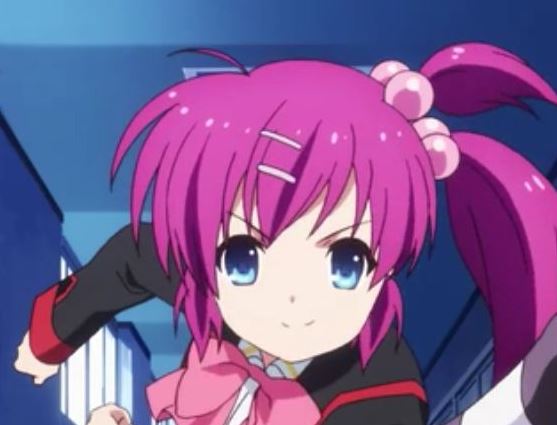
Haruka Saigusa (三枝 葉留佳, Saigusa Haruka) is one of the main characters in the visual novel and anime series Little Busters!. She becomes the eighth member to join the Little Busters group, bringing with her a lively and unpredictable energy that contrasts with the rest of the team.
Personality
Appearance in Anime
Haruka Saigusa is energetic, mischievous, and often unpredictable. She thrives on creating chaos and enjoys provoking others, particularly the Public Morals Committee, as a way to challenge authority and rebel against her past. Her loud and playful nature frequently masks the emotional pain she carries from her difficult upbringing.
Despite her seemingly carefree behavior, Haruka is deeply sensitive and vulnerable. She uses humor and disruption as a shield to cope with her family trauma and the strained relationship with her twin sister, Kanata. Beneath her antics lies a kind and determined individual who seeks acceptance and emotional healing, often revealing a more tender side when around those she trusts.
Appearance
Haruka Saigusa shares many physical traits with her twin sister, Kanata Futaki, including her pale skin and magenta-colored hair. To differentiate herself, Haruka ties her hair into twin ponytails and wears two hair clips at the front of her forehead. She has dark blue eyes and a notably expressive appearance that complements her energetic personality.
Her school uniform is the standard attire worn by the female students at her school. However, Haruka personalizes her look by wearing distinctive striped stockings, adding to her playful and rebellious image.
Biography
Haruka Saigusa is a classmate of Riki Naoe, though she belongs to a different class. Despite this, she frequently visits Riki’s classroom and often inserts herself into the daily activities of the Little Busters. Known as a “problem child,” Haruka regularly stirs up chaos for her own amusement, drawing the attention of the Public Morals Committee particularly its chairman, her twin sister, Kanata Futaki. To evade capture, she often uses marbles as a distraction and will hastily flee the scene, occasionally dragging Riki along with her and warning him about the consequences of being caught.
Beneath her playful and disruptive exterior lies a troubled past. Haruka was subjected to abuse by her extended family, while her parents were kept away from both her and Kanata. Although Kanata appeared to be treated better, she too suffered in silence. Haruka’s rebellious behavior is a form of resistance both as a way to get back at her family and to challenge the image her sister upholds. In addition to her antics, she works part-time in the school cafeteria to gain access to the kitchen, where she enjoys baking muffins and cakes.
Relationships
-
Kanata Futaki: Kanata is Haruka’s older twin sister. The two initially shared a hostile relationship, with Kanata viewing Haruka as a constant troublemaker due to her rebellious behavior. Their deep-seated animosity was rooted in unresolved family issues and emotional trauma. However, following the resolution of their familial conflicts, the sisters begin to rebuild their relationship and gradually come to care for one another.
-
Shou Saigusa: Shou is one of Haruka’s two fathers and is considered to be her biological parent, though the exact parentage is never definitively confirmed. His role in Haruka’s upbringing is part of the complex dynamic that contributes to her troubled family background.
-
Riki Naoe: Riki is one of Haruka’s closest friends and a fellow member of the Little Busters. He plays a central role in helping her confront and resolve her emotional struggles. In Haruka’s route in the visual novel, the two develop a romantic relationship, though this aspect is exclusive to her story arc.
-
Masato Inohara: Masato is Haruka’s friend and teammate. Both are known as the most comedic and playful members of the Little Busters, often engaging in lighthearted antics. Haruka enjoys teasing Masato, and their interactions help maintain a cheerful atmosphere within the group.
-
Yuiko Kurugaya: Haruka looks up to Yuiko as a mature and reliable figure. The two become close friends, with Yuiko adopting a protective, older-sister-like role toward Haruka and the other girls. Haruka affectionately calls her “Anego” (meaning “elder sister”) and, though rarely and never to her face, sometimes refers to her as “Yui-nee.”
-
Kudryavka Noumi: Haruka shares a warm friendship with Kudryavka, another member of the Little Busters. She affectionately gives her nicknames such as “Kuu-ko” or “Kudo-ko.”
-
Mio Nishizono: Haruka is also close friends with Mio and often refers to her by the playful nickname “Miocchi.”
-
Kyousuke Natsume: Kyousuke is the leader of the Little Busters. While he does not directly intervene, his actions particularly those involving Riki play a supporting role in helping Haruka face her personal challenges.
Etymology
Haruka’s given name is composed of the kanji 葉 (ha, meaning “leaf,” “blade,” or “fragment”), 留 (ru, meaning “detain,” “halt,” or “stay”), and 佳 (ka, meaning “good” or “beautiful”). Together, her name can convey a poetic or multifaceted meaning and can also be interpreted as “far away,” which aligns with the thematic undertones of her character.
When paired with her sister’s name, Kanata (meaning “beyond” or “distant”), the two names form the phrase Haruka Kanata (遥か彼方), which translates to “(really) far away.” This phrase is also the title of a vocal track featured in the Little Busters! visual novel, further tying their names to the emotional narrative of the series.
Her surname, Saigusa (三枝), combines the kanji 三 (sai, meaning “three”) and 枝 (gusa, meaning “branch”), symbolizing familial or relational themes, possibly referencing the complex structure of her family background.