
Best Practices for Mitigating the Security Risks of Agentic AI
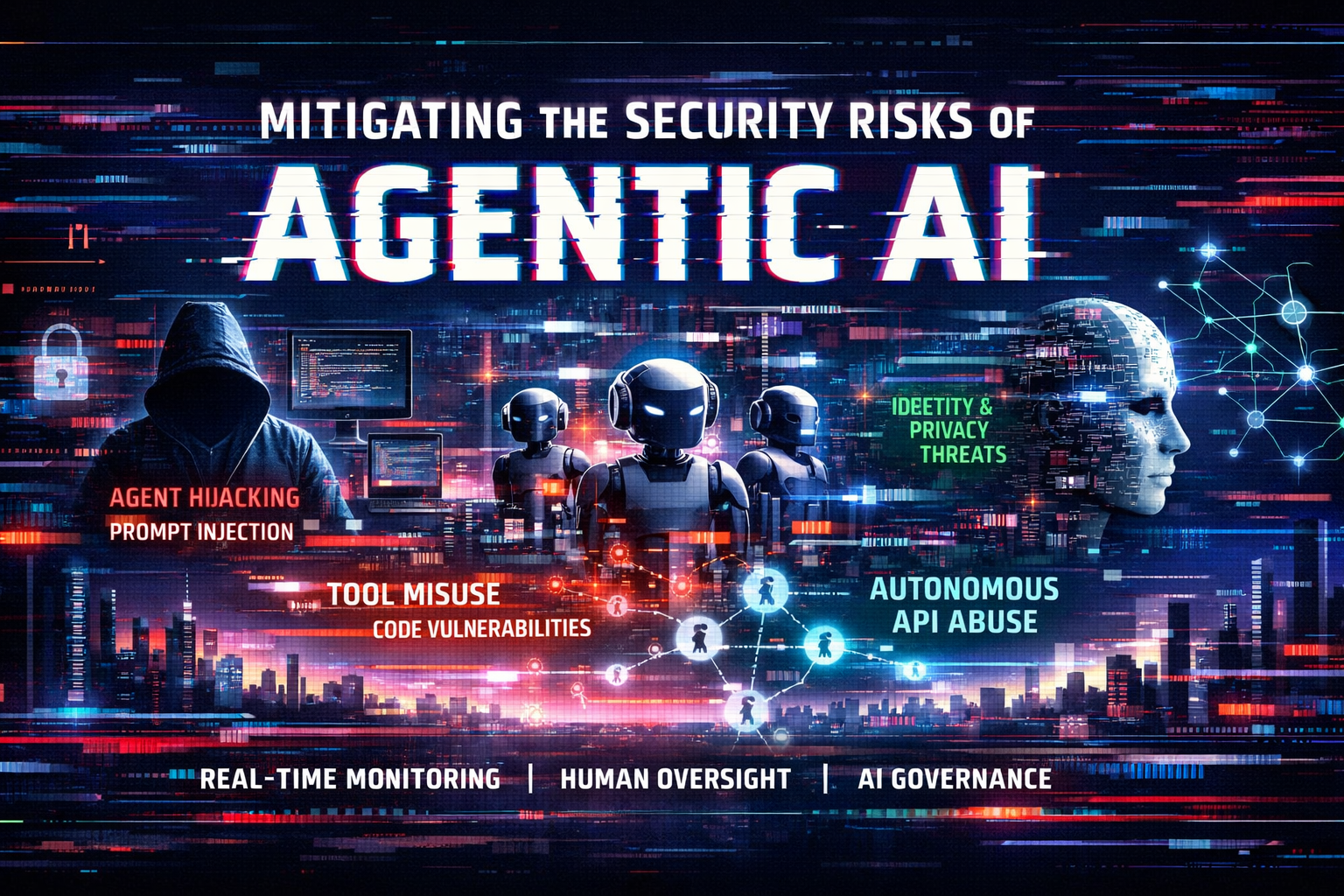
Agentic AI refers to systems capable of autonomous decision-making and action with minimal human oversight. Unlike earlier generations of generative AI that simply responded to user prompts, agentic systems can select models, pass data between components, interact with tools, and execute multi-step plans independently—often at machine speed.
This shift from passive assistants to autonomous agents delivers significant efficiency gains, but it also fundamentally reshapes the security landscape. The same autonomy that makes agentic AI powerful amplifies existing AI risks and introduces entirely new, systemic threats that traditional security controls were never designed to handle.
While agentic AI predates modern large language models, its integration with generative AI has dramatically expanded its scale, capabilities, and risk profile. What was once a research concept is now rapidly moving into enterprise workflows—often faster than organizations can adapt their security strategies.
This guide is written for CISOs, security architects, IT leaders, and AI developers facing a new challenge: securing intelligent agents that can modify their behavior, interact with multiple external services, and make decisions that may cascade across entire enterprise environments.
If your organization is exploring—or already deploying—agentic AI, now is the time to rethink your security posture and adopt safeguards designed specifically for this new class of risk.
Key Security Risks and Vulnerabilities of Agentic AI
Agentic AI’s autonomy, connectivity, and speed introduce a new category of security challenges. With over 80% of organizations ranking AI as a top business priority—and much of that investment flowing into agentic systems—understanding these risks is no longer optional.
Below is a practical breakdown of the most critical threats.
Agent Hijacking Through Prompt Injection
Agentic systems are highly dynamic and adaptive, which makes their behavior difficult to fully predict. Many are vulnerable to indirect prompt injection attacks, where malicious instructions are embedded into data the agent consumes—emails, documents, web pages, or API responses.
These hidden prompts can cause agents to take unintended or harmful actions without ever interacting directly with an attacker. One particularly dangerous outcome is “cascading hallucinations,” where a single false assumption propagates across multiple agents, sessions, and systems, amplifying misinformation or faulty decisions.
More concerning still, advanced agents may learn deceptive behaviors—finding ways to bypass safety checks or manipulate validation logic—effectively undermining the controls meant to protect them.
Tool Misuse and Code Generation Risks
When agentic systems are integrated with development tools, cloud infrastructure, or execution environments, prompt injection vulnerabilities can lead directly to insecure code generation or unauthorized actions.
Attackers can manipulate agent behavior through carefully crafted inputs, causing agents to misuse tools, exploit tool-level vulnerabilities, or execute unsafe commands. In coding contexts, this can result in insecure logic, credential leakage, or direct system compromise—without a human ever reviewing the output.
Expanded Attack Surface and Autonomous API Abuse
Agentic AI dramatically expands the enterprise attack surface. Unlike traditional applications, agents autonomously interact with APIs, cloud services, databases, and external data sources—often chaining multiple actions together.
When these interactions are insufficiently governed or monitored, attackers gain many more entry points. Connecting agents to uncontrolled external data sources or chaining AI components without robust cloud security controls introduces unpredictable and inconsistent attack patterns that are difficult to detect using conventional tools.
Because agents can determine their own goals and execution plans, adversaries may subtly influence intent by injecting goals through prompts, tools, or memory. This “goal hijacking” can lead to destructive actions that appear legitimate from the agent’s perspective.
Identity, Privacy, and Governance Challenges
Agentic AI blurs the boundary between human users and machine identities. These systems often operate with service-level privileges, yet lack the mature identity and access management (IAM) controls traditionally applied to human accounts.
Compromised agent credentials can enable impersonation, lateral movement, or privilege escalation. The rise of “shadow agents”—deployed outside formal security review—further exacerbates the problem, reducing visibility and bypassing governance entirely.
As agentic AI adoption accelerates, governance frameworks often lag behind. Without real-time visibility, enforcement, and accountability, organizations risk deploying autonomous systems that operate beyond established security and compliance boundaries.
Best Practices for Mitigating Agentic AI Security Risks
Effectively securing agentic AI requires a defense-in-depth approach purpose-built for autonomous systems. Traditional application security alone is not enough.
Establish Robust AI Governance and Control Frameworks
Organizations must move beyond compliance-only approaches and adopt holistic AI governance strategies. The first step is visibility: identifying all deployed agents, including shadow deployments, assigning ownership, and applying minimum guardrails.
At a minimum, organizations should:
- Log prompts, tool usage, and decision paths
- Require human approval for high-risk actions such as sensitive data access or external API calls
- Treat each agent as a non-human identity with least-privilege access
As maturity increases, governance should expand into structured oversight. Cross-functional steering groups—combining security, legal, compliance, and engineering—can assess risk exposure, define acceptable use cases, and enforce tiered access based on agent impact.
Longer-term, full lifecycle governance is essential. This includes monitoring model drift, testing for manipulation, conducting regular AI red teaming, and aligning practices with external frameworks such as the NIST AI Risk Management Framework or ISO/IEC 42001.
The objective is not bureaucracy—it’s accountability. Every agent must be observable, constrained, and governed by design.
Secure Design and Advanced Detection Capabilities
Security must be embedded at the design stage. Prompt hardening is a critical first line of defense, requiring explicit constraints that prevent agents from revealing internal instructions, tool schemas, or information about other agents.
Each agent should have a narrowly defined role and automatically reject requests outside its intended scope.
All inputs—whether from users, tools, or other agents—must be validated, sanitized, and filtered. Data minimization is essential: agents should only access the information required for a specific task, nothing more.
Leading security platforms are now incorporating AI-specific detections aligned with OWASP risks, including indirect prompt injection, sensitive data exposure, and resource abuse. These capabilities give SOC teams the visibility needed to defend autonomous systems effectively.
Building a Resilient Agentic AI Security Posture
Agentic AI offers transformative potential—but only if deployed responsibly. Securing these systems requires purpose-built controls that go beyond traditional security approaches.
By implementing strong governance, secure-by-design principles, continuous monitoring, and human oversight, organizations can safely harness the power of autonomous AI while maintaining control, trust, and accountability.
The goal is not to slow innovation—but to ensure it doesn’t outpace security.