
Silk Road (marketplace)
Silk Road |
|
|---|---|
 |
|
| Type of site | Darknet market |
| Available in | English |
| Owner | Ross Ulbricht (pseudonym Dread Pirate Roberts) |
| Commercial | Yes |
| Registration | Required |
| Launched | February 2011 |
| Current status | Shut down by FBI in October 2013. Silk Road 2.0 shut down by FBI and Europol on 6 November 2014. |
| URL | Old URL: silkroad6ownowfk.onion (defunct) New URL: silkroad7rn2puhj.onion (defunct) |
History
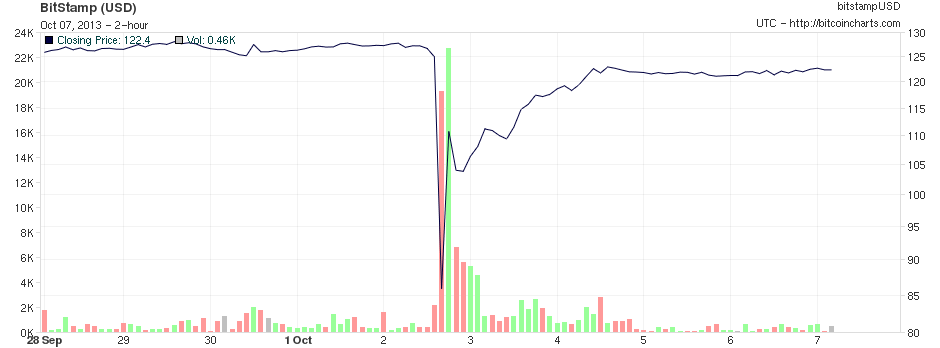
Effect of the Silk Road seizure on the Bitcoin to US dollar exchange rate
Silk Road was launched in February 2011 by Ross Ulbricht under the pseudonym Dread Pirate Roberts, inspired by the historical trade routes of the same name and the fictional character from The Princess Bride. Ulbricht, along with close collaborators known as Variety Jones and Smedley, operated the site on the Tor network, allowing users to buy and sell goods anonymously using bitcoin. The marketplace gained notoriety after media coverage in June 2011, leading to calls from U.S. authorities, including Senator Chuck Schumer, to shut it down. Silk Road briefly suffered a DDoS attack in May 2013, but continued to operate, facilitating a large volume of anonymous transactions.
Arrest and Trial of Ross Ulbricht
On 1 October 2013, Ulbricht was arrested in San Francisco by the FBI. Investigators traced Silk Road to him through his online activity and email accounts. During the arrest, the FBI seized his laptop and approximately 144,000 bitcoins, worth $28.5 million at the time. Ulbricht was charged with narcotics trafficking, money laundering, computer hacking, running a continuing criminal enterprise, and conspiracy. He was also accused of hiring hitmen, though no murders occurred, and he was never prosecuted for those allegations.
Ulbricht’s trial began in January 2015. Evidence, including chat logs and transaction records, demonstrated that he managed Silk Road for several years. On 4 February 2015, he was convicted on seven charges, including running a criminal enterprise and narcotics trafficking. He received two life sentences without parole plus forfeiture of $183 million. Appeals were denied, and the Supreme Court declined to review the case. On 21 January 2025, Ulbricht received a full pardon from President Donald Trump, after more than 11 years in prison.
Other Related Arrests
Silk Road activity led to convictions in other countries. In 2013, an Australian dealer was jailed for importing drugs via Silk Road. A New Zealander received a two-year sentence for methamphetamine purchases, and a Dutch dealer, Cornelis Jan Slomp, was sentenced to 10 years in 2015. In total, over 130 arrests were linked to the marketplace.
Products
By March 2013, Silk Road offered around 10,000 products, with approximately 70 percent consisting of drugs. These were categorized as stimulants, psychedelics, prescription medications, opioids, ecstasy, dissociatives, steroids, and precursors. Other items included fake identification documents and legal goods such as apparel, art, books, erotica, and writing services. A separate sister site, “The Armoury,” briefly sold firearms in 2012 but was shut down due to low demand.
Silk Road had strict rules prohibiting the sale of items intended to harm or defraud, including child pornography, weapons, assassinations, and stolen credit cards, setting it apart from other darknet markets that were less restrictive. Buyers could leave reviews and participate in forums, helping to identify reputable sellers and avoid scams. Most products were mailed, and the site provided guidance on packaging to reduce the risk of detection. Access to Silk Road was exclusively through the Tor network.
Sales
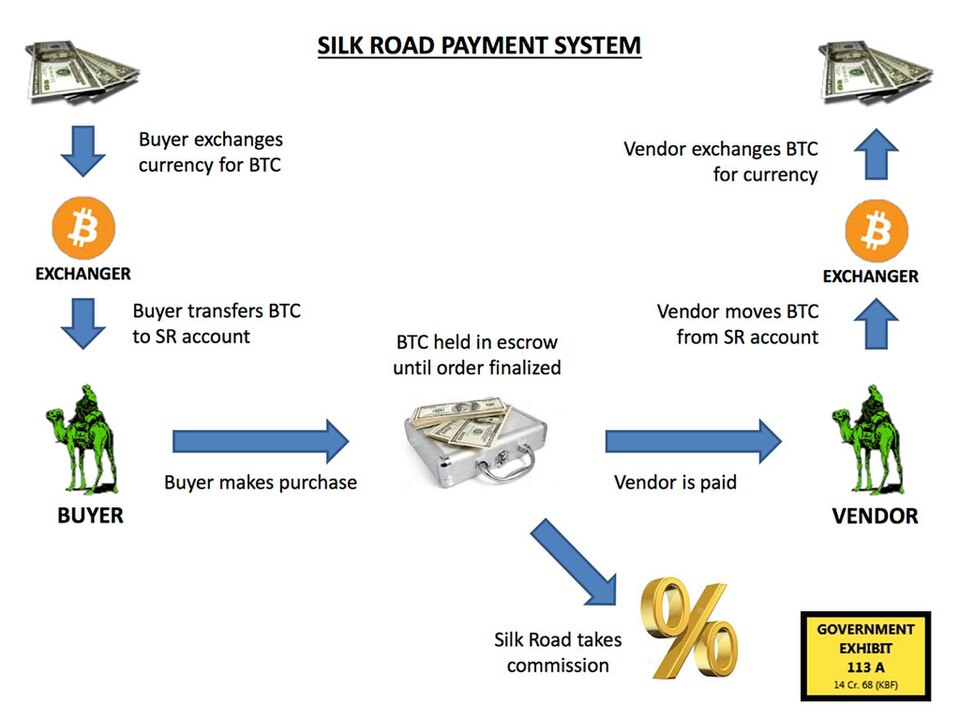
Flowchart illustrating Silk Road’s payment system, shown as Exhibit 113 A in evidence at Ulbricht’s trial
Silk Road served over 100,000 buyers during its operation, generating around $183 million in sales and $13 million in commissions at the time. Adjusted for the rise in bitcoin value, total revenue and commissions are sometimes estimated at $1.2 billion and $80 million.
New seller accounts were initially limited and sold via auction, later replaced by a fixed fee. All transactions used bitcoin, providing partial anonymity. Payments were held in escrow until orders were confirmed, and sellers could fix the bitcoin value of sales to U.S. dollars to protect against cryptocurrency volatility, with any differences covered by Dread Pirate Roberts.
According to the FBI, from February 2011 to July 2013, Silk Road completed approximately 1.23 million transactions, totaling 9.5 million bitcoins in revenue and 614,305 bitcoins in commissions. The platform involved 146,946 buyers and 3,877 vendors, with 30 percent of users from the United States and others from countries including the United Kingdom, Australia, Germany, Canada, Sweden, France, Russia, Italy, and the Netherlands. Over a two-month period in 2013, users exchanged more than 1.2 million private messages on the site.
Similar sites
The Farmer’s Market was a Tor site similar to Silk Road, but it did not use bitcoin. Considered a proto-Silk Road, it relied on payment services like PayPal and Western Union, which allowed law enforcement to trace transactions, leading to its shutdown by the FBI in 2012. After Silk Road’s closure, other darknet markets emerged to fill the gap. Atlantis launched in March 2013 but closed six months later, and Project Black Flag shut down in October 2013; both sites reportedly stole users’ bitcoins. Black Market Reloaded temporarily closed in October 2013 after its source code was leaked. By May 2015, The Economist had analyzed the market shares of various Silk Road successor sites.
Book Club
Silk Road hosted a Tor-based book club that continued operating even after the site’s closure and the arrest of a member. The club featured reading material on conspiracy theories, computer hacking, and mainstream topics, including titles such as The Anarchist Cookbook and Defeating Electromagnetic Door Locks. Many of the books were pirated. The club still exists today as a private Tor-based chatroom.