
Sousuke Sagara
Sousuke Sagara |
|
|---|---|
 |
|
| Alias | قاسم (Kashim) Isegar Sousuke Sousky Seagal |
| Personal Information | |
| Gender | Male |
| Call Sign | Urzu 7 |
| Rank | Sergeant |
| ID Number | B-3128 |
| Grade | 2 |
| Class | 4 |
| Weapons | Rk-91 Savage Rk-92 Savage M6A3 Dark Bushnell M9E Gernsback ARX-7 Arbalest ARX-8 Laevatein |
| Debuts | |
| Anime | The Guy I Kinda Like is a Sergeant |
| Portrayal | |
| Japanese Voice | Tomokazu Seki |
| English Voice | Chris Patton |
Appearance
Appearance in Anime
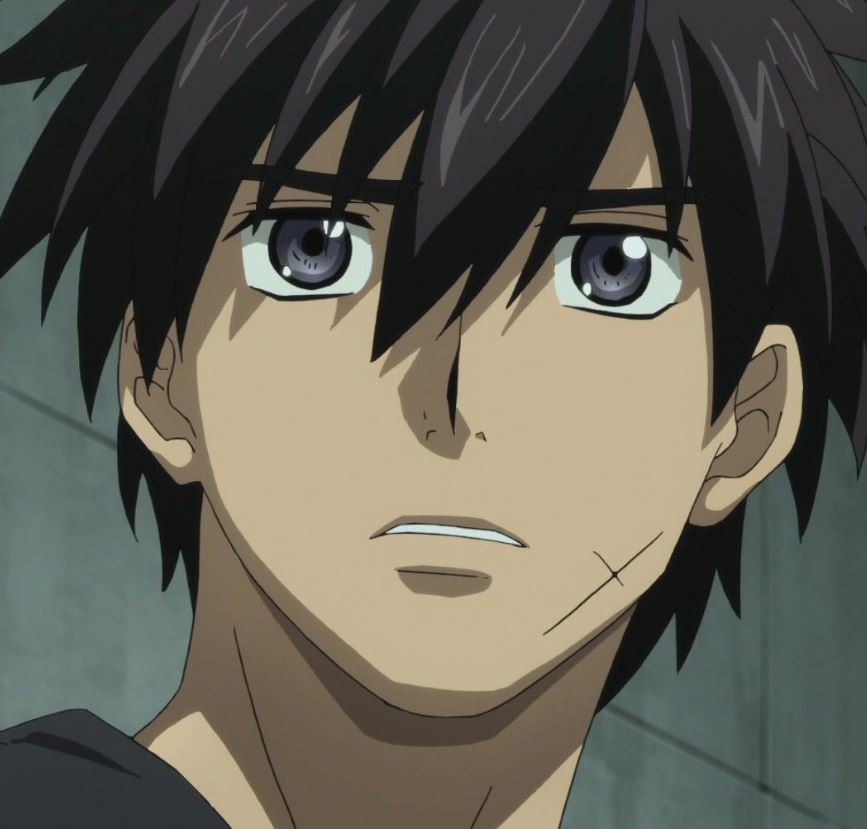
Sousuke is a teenager of medium height with a lean, muscular build, tan skin, and brown hair and eyes. His hair is slightly unkempt, with bangs falling to the right side of his face, and he bears a distinctive X-shaped scar on the lower left of his chin. He is almost always depicted with a serious expression, reflecting his soldierly upbringing.
While attending Jindai High School, Sousuke typically wears his school uniform. In winter, this consists of a black blazer and matching trousers, while in summer, he switches to a white buttoned shirt with the same trousers. Outside of school, he often dresses in practical or military-style clothing, prioritizing function over appearance.
Though considered reasonably handsome, Sousuke’s lack of fashion sense, social awareness, and his ingrained paranoia often leading him to use military tactics and weapons inappropriately in civilian life cause others, particularly his classmates, to view him as strange or even dangerous. His tendency to cause accidental property damage through these behaviors further isolates him socially, despite his well-meaning intentions.
Personality
Sousuke’s personality is heavily shaped by his upbringing in war-torn regions, where he was raised as a child soldier and constantly exposed to violence, loss, and survival-driven instincts. As a result, he is deeply paranoid, militaristic, and socially inept, often responding to ordinary situations as if they were life-threatening combat scenarios. The smallest irregularity can trigger him to draw weapons, set traps, or cause large-scale destruction, often to the detriment of those around him. His extreme caution extends to his personal life, leaving him emotionally guarded and hesitant to trust either himself or others.
Despite this, Sousuke is not inherently cruel. At his core, he is a goodhearted and hardworking individual, motivated by a desire to protect those close to him. His well-meaning nature, however, is frequently obscured by his poor judgment in civilian settings and his reliance on military solutions for everyday problems. Over time, with the help of Kaname Chidori, he gradually develops common sense, empathy, and an understanding of social relationships, learning to see people not just as allies or enemies but as individuals with emotional depth.
Sousuke’s social and emotional development is a central aspect of his character arc. Initially, he is almost completely detached rarely laughing, smiling, or forming personal bonds. His assignment to guard Chidori becomes a turning point, allowing him to experience life beyond the battlefield. He learns to express emotions, to value friendships beyond military camaraderie (notably with Kurz Weber and Melissa Mao), and to form deeper bonds with his commanding officer, Teletha “Tessa” Testarossa. Ultimately, his strongest connection is with Chidori, the person with whom he feels the most vulnerable and comfortable. Moments such as allowing her to cut his hair, falling asleep in her presence, or defying orders to protect her demonstrate his trust and affection.
Sousuke’s struggles also extend to romance. While he is protective and even gentlemanly going so far as to set traps to safeguard his female friends’ privacy during a hot springs trip he is awkward and unsure in romantic situations. His entanglement in a love triangle with Tessa and Chidori highlights his confusion and emotional immaturity. Nevertheless, his relationship with Chidori becomes transformative, allowing him to suppress his survival instincts in moments of crisis and ultimately embrace his humanity. During the climactic battle at Merida Island, he even resists killing his mentor, Andrey Kalinin, whom he once regarded as a father figure, and later weeps at the thought of losing Chidori, marking his growth from a detached soldier into someone capable of love, longing, and emotional vulnerability.
Overview
Sousuke Sagara is approximately sixteen to seventeen years old and serves as a sergeant in Mithril, a private paramilitary counter-terrorist organization. He is assigned to the Special Response Team (SRT) of the Western Pacific Battle Group aboard the assault submarine Tuatha de Danaan, commanded by Captain Teletha “Tessa” Testarossa. His call sign is Urzu-7 and his identification number is B-3128. Serious and disciplined, Sousuke operates as a point man and Arm Slave specialist, piloting the advanced mecha ARX-7 Arbalest.
Sousuke’s origins differ across media. In the light novels, he is described as being of Japanese descent. The manga depicts him as Afghan-born, raised there after a series of events connected to General Majhid, a man he was originally ordered to assassinate but later lived with. In the anime, Sousuke’s birthplace is the fictional country of Helmajistan, a stand-in for Afghanistan. His exact birthdate remains unknown, though his official records list it as July 7, 1984.
His true name is also ambiguous. While his helmet bears the name Sousuke Sagara, as given to him by his mentor Andrey Kalinin, the shirt he wore as a child had the words Sousuke Sangal printed inside. Since Sangal refers to a location rather than a personal name, fans have speculated whether it indicated his place of origin rather than his given name.
Sousuke has dark brown hair, gray eyes, and a small cross-shaped scar on the left side of his chin. He is fluent in English, Japanese, and Persian, and can also speak Russian and several Afghan dialects. Raised in a Muslim environment during his childhood, he was once devout enough to memorize the Qur’an, though as a teenager he is largely secular. His refusal of alcohol stems from personal distaste rather than religious belief, though he still demonstrates cultural awareness for instance, considering Ramadan in tactical terms rather than religious ones.
As a soldier, Sousuke is highly skilled in Arm Slave operations and maintenance, improvised explosives, small arms, anti-armor combat, demolitions, logistics, survival training, covert intrusion, and hand-to-hand combat. His extensive experience as both a guerrilla fighter and mercenary makes him adept in unconventional warfare, often employing irregular tactics that differ from standard military doctrine.
Despite his impressive combat background, Sousuke’s military life leaves him socially inept. He interprets almost every situation in a militaristic framework, often applying battlefield logic to daily life. This creates frequent problems in his assignment to protect Kaname Chidori, as Sousuke routinely misreads civilian behavior, carries firearms at school (albeit with non-lethal rounds), and employs excessive force when assessing threats. His oft-repeated axiom, “a peaceful solution is always best,” is ironically framed in military terms, sometimes delivered after intimidating others with drawn weapons.
His inability to grasp “normal” civilian life is a central source of the franchise’s comedy and character development, especially in the spin-off Fumoffu!, which focuses on his misadventures adapting to high school. For example, he once misinterprets the term “real-life fight” in martial arts as a call to actual combat readiness.
Throughout his career, Sousuke has also operated under multiple aliases, including Sousuke Seagal, Isegar Sousuke, and Kashim the latter being his identity during his guerrilla days in Afghanistan (or Helmajistan in the anime). Characters such as Gauron and Zaid continue to refer to him by this name, underscoring the lasting impact of his violent past.
Relationships
Kaname Chidori
Sousuke’s closest and most important relationship is with Kaname Chidori, the high school girl he is assigned to protect due to her Whispered abilities. Initially, their relationship is defined by frequent misunderstandings Sousuke’s militaristic mindset and lack of social skills often frustrate Kaname, while her temper and sarcasm clash with his literal approach to life. Despite the comedic friction, Sousuke grows emotionally attached to her, gradually learning to trust, relax, and express genuine care. Over time, their bond evolves into a deep mutual affection, with Sousuke eventually acknowledging his romantic feelings for her.
Teletha “Tessa” Testarossa
Sousuke shares a close but complicated relationship with Captain Teletha Testarossa, his superior officer aboard the Tuatha de Danaan. Tessa values Sousuke’s skills and often shows him personal attention, which sometimes places him in awkward romantic situations. While Sousuke respects Tessa and forms a friendship with her, his loyalty and emotional focus remain centered on Kaname, creating a subtle love triangle that highlights his uncertainty in handling personal relationships.
Kurz Weber and Melissa Mao
Sousuke develops strong camaraderie with his Mithril teammates Kurz Weber and Melissa Mao, who initially treat him as a socially awkward but talented soldier. Over time, their relationship evolves from mere colleagues to genuine friends, with Mao often taking on a protective, older-sister-like role, while Kurz provides comic relief and encouragement. Their influence helps Sousuke grow beyond his isolated military persona and experience a sense of normal companionship.
Andrey Kalinin
Sousuke regards Andrey Kalinin as both a mentor and a father figure, as Kalinin rescued him during his childhood and guided his path into Mithril. However, their relationship is strained by Kalinin’s secretive past and his complicated motives. In the climactic events of the story, Sousuke is forced to confront Kalinin, ultimately choosing not to kill him despite his instincts, signaling both his personal growth and the complexity of their bond.
Etymology
The given name Sousuke (宗介) can be interpreted as “religion, sect, denomination, origin, essence” (宗, sō) combined with “forerunner, herald, or mediator” (介, suke). His surname, Sagara (相良), is composed of “phase, aspect, or countenance” (相, saga) and “good, virtuous, respectable” (良, ra). Together, the name reflects connotations of virtue, respect, and guidance, which contrast with his upbringing as a child soldier and highlight his development into a protector figure throughout the series.