
Chihiro Fujisaki
Chihiro Fujisaki |
|
|---|---|
 |
|
| Kanji | 不二咲 千尋 |
| Romaji | Fujisaki Chihiro |
| Katakana | フジサキ チヒロ |
| Personal Information | |
| Gender | Male |
| Birth Date | March 14 |
| Participated in | Killing School Life |
| Affiliation | Hope’s Peak Academy Class 78th |
| Previous Affiliation | St. Elbandia Academy Yūto Kamishiro’s Agent |
| Status | Deceased |
| Debuts | |
| Anime | Danganronpa: The Animation – Episode 01 |
| Manga | Danganronpa: The Manga |
| Portrayal | |
| Japanese Voice | Kōki Miyata |
| English Voice | Kara Edwards |
Appearance
Appearance in Anime
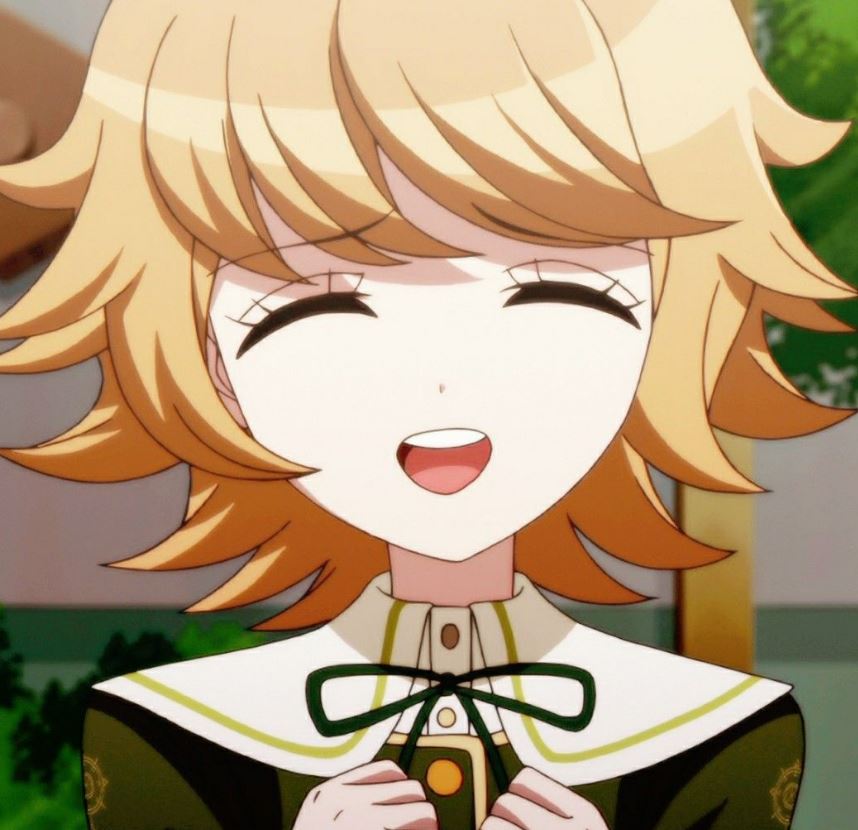
At the beginning of the Killing School Life in Danganronpa: Trigger Happy Havoc, Chihiro appears to be a young high school-aged teenager, though due to the memory loss inflicted by Hope’s Peak Academy, he is actually two years older than he believes. Chihiro has a delicate, almost doll-like appearance, with a small and slender build that emphasizes his timid nature. He has short, layered light-brown hair and soft hazel eyes, giving him a gentle and unassuming look.
Chihiro dresses in a modified version of a girls’ winter school uniform. His outfit consists of a long-sleeved dark green jacket worn over a white blouse with a large Peter Pan collar, secured with a thin dark ribbon. He also wears suspenders, a box-pleated brown skirt that falls to mid-thigh, knee-high black socks, and white mary janes adorned with small ribbons. The emblem of his former school, St. Elbandia Academy, is displayed on his buttons and embroidered along the sides of his socks.
Notably, his choice of attire and soft presentation contribute to the initial impression that Chihiro is female, a misconception that becomes significant in the narrative. Supplemental materials describe that during his school years he wore white bloomers patterned with yellow polka dots, a reflection of his deep-seated insecurities and fear of being perceived as weak.
Personality
Chihiro is highly intelligent and gifted in programming, but his personality is defined by his meekness and timidity. He is extremely shy, polite to a fault, and apologizes often, becoming easily flustered or intimidated to the point of tears. Despite this, when the subject of computers or programming arises, Chihiro shows a different side of himself, speaking with enthusiasm and genuine passion for his craft.As the Ultimate Gambler, Celestia is outwardly calm, cunning, and calculating. She is a master manipulator, able to lie without hesitation and bend others to her will, as shown when she persuaded Hifumi Yamada to serve her and later convinced him to become her accomplice in Chapter 3. Highly intelligent, she frequently references concepts from game theory such as the Prisoner’s Dilemma and Zero-Sum Games, and her analytical skills allow her to keep pace with figures like Kyoko Kirigiri and Byakuya Togami during Class Trials. Celestia regularly contributed key insights during investigations, masking her lies behind an air of rationality and composure.
He is among the kindest and most gentle characters in Danganronpa, to the extent that he once remarked he would not harm even a mosquito, reasoning that it might be hungry or have a family of its own. Chihiro carries deep empathy for others, often feeling guilt even for things outside of his control, such as Leon Kuwata’s execution. He is deeply uncomfortable with conflict, openly expressing his dislike for disputes between friends and trying to ease tensions whenever possible.
However, beneath his soft-hearted nature lies a painful insecurity. Since childhood, Chihiro was bullied for being frail and was pressured to “act tougher” because he was a boy. Struggling with feelings of weakness, he began disguising himself as a girl to avoid the expectations of masculinity, but this choice only deepened his feelings of shame and isolation. Although he tried to hide it, Chihiro was uncomfortable when treated as female, and he longed for acceptance as himself. He admired physically strong men and wished to emulate them, openly rejecting the idea of training with Sakura Ogami in school mode because his ideal was to have a strong male role model. According to official artbook notes, his true wish was not simply to be strong for himself, but to protect others.
When Monokuma threatened to expose the students’ secrets including Chihiro’s gender, he initially resolved to share the truth of his own will. Rather than succumb to despair, he found determination to overcome his weakness and strive toward being his true self. Tragically, he did not realize that his honesty, courage, and willingness to face his insecurities already showed a profound inner strength.
In lighter scenarios such as school mode, Chihiro reveals more about his interests and fears. He enjoys reading and baking, and has a fondness for small animals like rabbits and hamsters, expressing a wish to one day keep one as a pet. On the other hand, he dislikes earthquakes, large crowds, and singing in front of others, all of which make him feel vulnerable.
Background
Chihiro Fujisaki was born into a wealthy family and grew up as a child prodigy in the field of programming. From a very young age, he displayed extraordinary talent with computers, developing complex software that earned him recognition in the tech world and eventually his place at Hope’s Peak Academy as the Ultimate Programmer.
Despite his brilliance, Chihiro’s personal life was defined by hardship. Due to his frail build and shy nature, he was frequently bullied throughout his childhood, especially by other boys who mocked him for being “weak.” The constant pressure to be stronger and more masculine left deep scars on his self-esteem. In order to protect himself from further ridicule and avoid the expectations placed upon him, Chihiro began presenting himself as a girl. While this disguise helped him cope in public, it only reinforced his insecurities and made him feel trapped in a false identity.
His struggles with self-worth carried into his time at Hope’s Peak Academy. Though he was surrounded by other talented students, Chihiro often felt inferior because his physical weakness contrasted so sharply with his classmates’ more outwardly impressive abilities. Still, he worked diligently at his craft and remained gentle and considerate toward others, always trying to be helpful in any way he could.
When Monokuma trapped the students inside Hope’s Peak and forced them into the Killing School Life, Chihiro’s secret became one of the most dangerous burdens he carried. Fearing exposure, he initially retreated further into timidity. However, as the killings progressed, he began to confront his fears and resolved to reveal the truth about himself to the others, hoping that by doing so he could begin to grow stronger as his true self.
Tragically, he never had the chance to take that step. In Chapter 2, seeking guidance and strength from Kiyotaka Ishimaru and Mondo Owada, Chihiro attempted to overcome his weakness. However, his decision to confide in Mondo led to devastating consequences, as Mondo struggling with his own insecurities murdered Chihiro in a fit of desperation. His death deeply affected his classmates, becoming a turning point in the Killing School Life.
Even after his passing, Chihiro’s legacy lived on through Alter Ego, an advanced AI program he created prior to the killing game. Alter Ego became a vital ally for the survivors, carrying on Chihiro’s will to protect and support his friends.
Talents and Abilities
Ultimate Programmer
Chihiro’s natural gift for programming emerged from his childhood, shaped largely by his weak health and his father’s influence. Too frail to spend much time outdoors, Chihiro often stayed inside and used the computer as both entertainment and an outlet for creativity. His father, Taichi Fujisaki, a talented software engineer himself, had left an unfinished voice-activated information retrieval system on the family computer. Curious and determined, Chihiro began experimenting with it, making modifications that improved its function. This early success showed him that he could not only understand existing code but also write his own programs from scratch.
His father’s praise for this achievement became a defining moment for Chihiro. It was the first time he felt genuine pride in himself, and it gave him the motivation to dedicate his life to programming. From then on, he immersed himself in developing increasingly advanced systems, building his reputation as a prodigy in the programming world.
Despite his insecurities about his physical weakness, Chihiro’s exceptional skills became his greatest strength. He felt that while he might not be useful in physical confrontations, he could contribute meaningfully with his technical knowledge. This mindset drove him to constantly refine his work, eventually achieving recognition as the Ultimate Programmer at Hope’s Peak Academy.
Chihiro’s programming genius left a lasting impact even after his death during the Killing School Life. His most important creation, Alter Ego, was an advanced artificial intelligence capable of independent thought and emotional interaction. Designed initially as a companion and assistant, Alter Ego went on to play a critical role in supporting the surviving students and helping them uncover the truth behind Monokuma’s manipulations.
Later, his legacy as a programmer extended beyond the walls of Hope’s Peak Academy. His work contributed to the eventual creation of the Neo World Program, an advanced virtual rehabilitation system central to the events of Danganronpa 2: Goodbye Despair. In this way, Chihiro’s talents continued to shape the future, fulfilling his desire to be helpful and protect others even when he could no longer be present himself.
Etymology
Chihiro (千尋) can be written with kanji meaning “thousand” (千) and “search” or “look for” (尋). Together, the name can be interpreted as “a thousand searches” or “one who seeks deeply,” which resonates with his identity as the Ultimate Programmer, always searching for answers and solutions through code.
Fujisaki (不二咲) is composed of “not two” (不二, fuji), a phrase often symbolizing uniqueness or something unparalleled, and “blossom” (咲, saki), meaning “to bloom.” The surname can be interpreted as “an incomparable bloom” or “a unique flower in bloom.” This reflects Chihiro’s individuality and hidden strength despite his fragile outward appearance.
The layered meanings of his name emphasize both his pursuit of knowledge and his uniqueness as a person—qualities that shine through even in the face of his insecurities.