
Michiru Matsushima
Michiru Matsushima |
|
|---|---|
 |
|
| Kana | 松嶋 みちる |
| Romaji | Matsushima Michiru |
| Aliases | Chiruchiru (by Makina Irisu) |
| Statistics | |
| Birthdate | December 25 |
| Height | 155 cm |
| Gender | Female |
| Status | Alive |
| Occupations | High School Student |
| Representative Fruit | Lemon |
| Representative Flower | Sunflower |
| Actors | |
| Japanese | Kaori Mizuhashi |
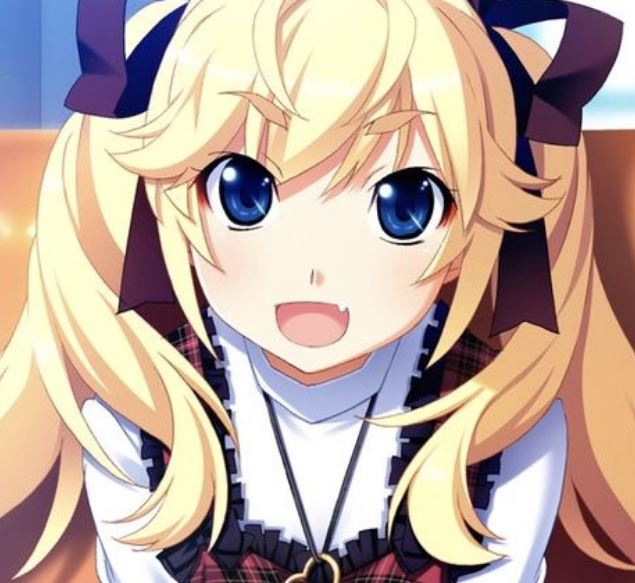
Michiru Matsushima (松嶋 みちる, Matsushima Michiru) is a second-year student at Mihama Academy and one of the main heroines of the Grisaia no Kajitsu (The Fruit of Grisaia) series. Known for her bleached blonde twin tails and exaggerated personality, Michiru is a self-proclaimed tsundere who imitates the archetype despite lacking its natural temperament. Her playful and energetic behavior makes her the comedic moodmaker of the class.
She is rarely seen without her signature shark-shaped pouch, which she uses to carry her favorite lemonade-flavored candies. Although she has a low tolerance for sour foods, she insists on drinking 100% pure Vitamin C juice, believing it will improve her intelligence. Despite a lifetime of misfortunes, Michiru remains resilient and always manages to bounce back in her own quirky way.
Appearance
Appearance in Anime
Michiru Matsushima has bleached blonde hair, typically styled into two distinctive twin ponytails. Her facial expressions often shift depending on her mood and are frequently exaggerated when portrayed in chibi form. Among the girls at Mihama Academy, Michiru has the second smallest bust larger than Makina Irisu’s but smaller than the others. In terms of height, she is below average but serves as the “middle ground” among the five female students, standing taller than Makina and Sachi, but shorter than Yumiko and Amane.
Her typical casual attire consists of a white button-up shirt paired with loosely fitted red shorts and thigh-high socks. She accessorizes with a ribbon tied around her left leg, a choker featuring a small gold pendant, and her signature pink shark-shaped pouch, which she wears around her waist and is rarely seen without. Even while in her school uniform, she continues to wear the pouch, adding to her distinct and playful appearance.
Personality
Michiru Matsushima exhibits a dual-layered personality, with two distinct sides that become especially apparent during her route in the Grisaia series. On the surface, she presents herself as an energetic, erratic, and self-proclaimed tsundere, an archetype she deliberately emulates due to her fascination with the character type. She frequently uses stock tsundere phrases and exaggerated behavior, often becoming the butt of jokes to lighten the mood or draw isolated classmates, such as Yumiko, into the group dynamic.
Despite her playful exterior, Michiru occasionally offers unexpected moments of insight and empathy, contrasting sharply with her usual antics. These glimpses of sincerity often surprise those around her, raising questions about her true nature and intelligence. Her outward behavior serves as a coping mechanism, an elaborate facade masking deeper emotional struggles.
Beneath this façade lies her “other self”: a second, darker personality that surfaces during times of psychological stress. This alternate persona is characterized by a more serious, nihilistic, and rational demeanor. It is also more emotionally grounded and hard-working, often stepping in when Michiru cannot handle difficult situations. While this personality retains complete awareness of Michiru’s actions, the reverse is not true Michiru typically has no recollection of what happens when her other self takes over.
Over time, and especially with Yuuji Kazami’s support, Michiru begins to confront and accept this hidden part of herself. In later entries of the series, such as the sequel visual novels and anime adaptation, she learns to synchronize with her alternate personality. This eventually allows for more direct communication between the two, leading to greater self-understanding and emotional stability.
Background
Michiru Matsushima was born into a relatively wealthy family that placed high expectations on her from an early age. Her parents hired private tutors to train her academically and artistically, including lessons in piano and other refined skills. However, Michiru struggled to meet their expectations, and her tutors grew increasingly frustrated. This led to instances of emotional abuse and bullying, which her parents remained unaware of. Over time, her parents began to doubt her potential, though they remained content that she at least appeared physically healthy.
This sense of stability was upended when Michiru was diagnosed with a heart condition. With her health now compromised, her parents’ remaining expectations faded, and they began to emotionally withdraw from her. As a result, Michiru fell into a deep depression, often isolating herself for long periods, believing that “sitting still was the only talent she had.”
Her school life was marked by loneliness and feelings of invisibility. At one of her lowest moments, while contemplating suicide from the rooftop of her school, Michiru encountered another girl preparing to do the same. Startled and envious of the girl’s resolve, Michiru called out to her, unintentionally saving her life. The encounter led to an unexpected friendship, and for the first time, Michiru began to find joy and interest in the world around her.
Tragically, the girl was unable to overcome her own despair and eventually took her life by jumping from the school building in front of Michiru. The shock of witnessing this event caused Michiru to collapse due to her heart condition. She was rushed to the hospital, where it was determined she needed a heart transplant. A matching donor was found in America, a young woman left paralyzed after a traffic accident and Michiru successfully received the transplant.
Following the surgery, Michiru began to display signs of dissociative identity disorder, resulting in the emergence of a second personality. This alternate persona, referred to as the “other Michiru,” was confident, intelligent, and outgoing the opposite of Michiru’s withdrawn self. While this new personality often helped her through difficult times, the mental burden of sharing her identity became overwhelming. At one point, Michiru attempted to harm herself by stabbing her chest in a desperate attempt to rid herself of the other personality.
She was hospitalized again, where she received medication to suppress her alter ego. During her time in recovery, Michiru noticed that her awkward behavior and clumsiness brought laughter and joy to those around her. Realizing that she could bring happiness to others, she resolved to craft a cheerful and quirky tsundere persona using comedy as a form of healing for both herself and others.
Eventually, Michiru was discharged and became the third student to enroll at Mihama Academy, a secluded institution for students with troubled pasts. There, she adopted her fabricated personality as a way to both fit in and continue bringing smiles to others.
Relationships
-
Yuuji Kazami: Amane’s relationship with Yuuji Kazami is complex and deeply rooted in guilt and emotional vulnerability. Upon learning that he is the younger brother of Kazuki Kazami, the girl who sacrificed herself so Amane could escape a deadly bus crash six years earlier, Amane initially viewed Yuuji as a form of retribution—a reminder of the past she could not atone for. She frequently flirted with Yuuji in a bold and suggestive manner, even expressing a desire to be his girlfriend, using this behavior as a façade to mask her unresolved guilt.
-
Yumiko Sakaki: Although not overtly shown to interact often in the early parts of the series, Amane maintains a close, almost sisterly relationship with Yumiko Sakaki. Amane’s natural onee-san personality resonates with Yumiko’s reserved nature, and their bond becomes more apparent in Grisaia no Meikyuu. Notably, Amane teaches Yumiko how to cook, subtly supporting her when she notices Yumiko’s growing desire to contribute to the group and care for Yuuji.
-
Michiru Matsushima: Amane finds Michiru amusing and light-hearted, appreciating her for the humor she brings to the group. In the manga adaptation of Michiru’s arc, it is revealed that Amane is fully aware that Michiru’s tsundere persona is an act. Although they are not particularly close on a personal level, Amane still values Michiru as a dear friend and fellow Mihama Academy resident, treating her with the same warmth and respect she offers the others.
Etymology
In the original Grisaia visual novel, Michiru’s name is written in hiragana as みちる, reflecting her main personality. In contrast, her alternate personality is represented using katakana as ミチル, visually distinguishing the two identities. In the official English translation, this distinction is conveyed by placing quotation marks around the alternate version of her name, referring to the other self as “Michiru.”
Her surname, Matsushima (松嶋), is composed of 松 (matsu), meaning “pine tree” or “fir tree,” and 嶋 (shima), meaning “island.”