
Shu Ouma
Shu Ouma |
|
|---|---|
 |
|
| Japanese | 桜満 集 おうま しゅう |
| Rōmaji | Ōma Shū |
| Statistics | |
| Relatives | Kurosu Ouma (Father) Saeko Shijou (Mother) Haruka Ouma (Stepmother) Shuichiro Keido (Step Uncle) Mana Ouma (Older Sister) Gai Tsutsugami (Step Cousin) Inori Yuzuriha (Girlfriend) |
| Affiliation | Funeral Parlor (Formerly) Student Council (Formerly) The King |
| Gender | Male |
| Status | Active |
| Height | 170 cm (5’7”) |
| Debut | |
| Manga | Chapter 1 |
| Anime | Episode 1 |
| Portrayal | |
| Japanese | Yuki Kaji Keiko Utsumi (child) |
| English | Austin Tindle Lara Woodhull (child) |
Shu Ouma(桜満 集,Ōma Shū) is the main protagonist of Guilty Crown. He possesses a special ability known as the King’s Power, which he acquires through the Void Genome, allowing him to draw weapons called Voids from people’s hearts. Shu is a second-year student at Tennouzu First High School, where he is part of Class 2-A and a member of the Modern Motion Picture Research Club. Over the course of the series, he becomes involved with the underground resistance group Funeral Parlor, where he plays a key role in their fight against GHQ.
Outside the main series, Shu makes appearances as a supporting character in Guilty Crown: Lost Christmas and Guilty Crown: Princess of Deadpool.
Appearance
Shu Ouma with the Apocalypse Virus across the right side of his face
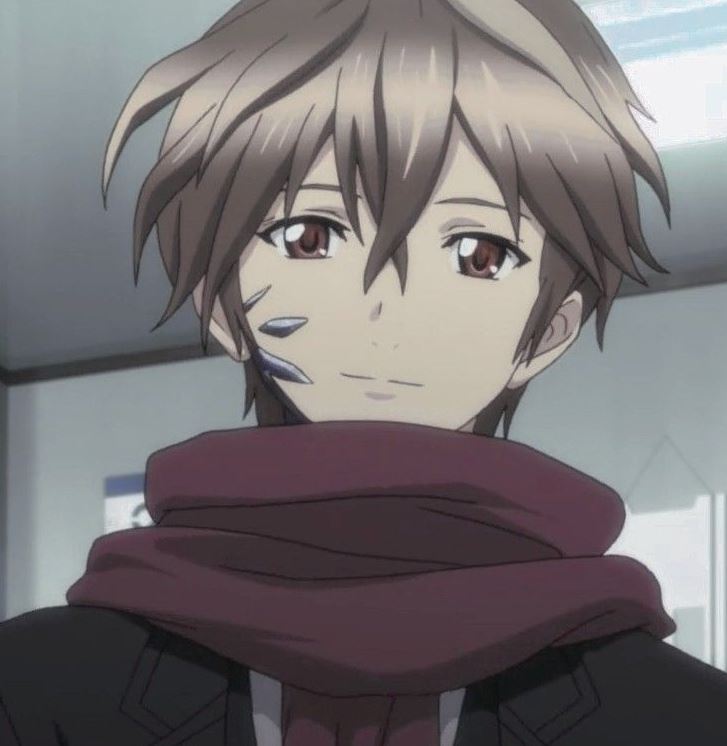
Shu Ouma has fair skin, scruffy brown hair with a distinctive blond streak at the crown, and red eyes. His hairstyle closely resembles that of his father, Kurosu Ouma. During his time with Funeral Parlor, he wears the organization’s standard uniform. After assuming the role of King of Japan, his attire changes to a green coat, a scarf, a white t-shirt, black pants, and a chain.
In Episode 17, Shu loses his right arm, which is later replaced with his Void in Episode 19 after injecting himself with the third Void Genome ampule. As a result, he also develops the Apocalypse Virus on the right side of his face, marking the first stage of infection.
In Guilty Crown: Lost Christmas, Shu appears as a 7-year-old child with similar features to his older self. However, he lacks the blond streak in his hair, instead having a cowlick, suggesting that his signature blond streak in the main story may have been dyed.
Personality
At the beginning of the series, Shu Ouma is a withdrawn and socially awkward individual who struggles with communication. He spends most of his time online, watching Egoist videos, and avoids forming deep connections with others. His lack of social awareness often results in him being insensitive or unintentionally rude, as he struggles to read between the lines in conversations. Many characters, including his friend Hare Menjou and even the mass murderer Kenji Kido, point out his inability to understand others’ emotions. Shu also has trouble making eye contact, admitting that it makes him nervous and causes him to forget what he wants to say. At times, he wonders if his mind functions differently from others, though this is never explicitly confirmed.
Shu initially lacks confidence and is reluctant to join Funeral Parlor, despite possessing the King’s Power, which could greatly aid their cause. He also experiences internal conflict over his loyalty to GHQ and the resistance, largely due to his resentment toward Gai Tsutsugami, whose manipulative nature and utilitarian philosophy clash with Shu’s morality. This earns him the contempt of several members of Funeral Parlor, particularly Argo Tsukishima. However, after the Leukocyte incident, Shu gains a newfound respect for Gai, realizing that while he can never be like him, he must find his own way to lead.
A turning point in Shu’s character occurs when he is forced to mercy-kill Jun Samukawa, the younger brother of his friend Yahiro Samukawa. This event deeply traumatizes him, making him realize that by using Voids, he has essentially been treating people including his friends as tools. Following this, Shu suffers a mental breakdown, leading Gai and Ayase Shinomiya to dismiss him from Funeral Parlor. The only person who continues to have faith in him is Inori Yuzuriha. With encouragement from Hare, Shu regains his resolve and decides to stand up for Funeral Parlor, asking for permission before using others’ Voids. This marks the beginning of his growth into a more courageous and socially adept individual, a change that Hare attributes to the influence of those around him.
However, Hare’s death causes a drastic shift in Shu’s personality. Misled by Yahiro about the circumstances of her death, Shu becomes cold, ruthless, and emotionless. He enforces Yahiro’s ranking system on the student body and assumes a dictatorial role, believing that strict discipline is necessary for their survival. His actions become increasingly harsh, particularly toward Souta Tamadate, whom he blames for Hare’s death. At one point, he deliberately allows Souta to nearly drown and later imprisons Argo for attempting to intervene. Despite his public persona as a tyrant, Shu expresses doubt about his own actions in private conversations with Inori and Ayase, questioning whether he will ever be punished for his wrongdoings. During this period, he becomes highly dependent on his Void powers, embracing the title of “King.” However, when Gai returns and severs Shu’s right arm, effectively stripping him of his power, Shu enters a state of shock.
Following the loss of his Void abilities and the betrayal of his supposed friends, Shu becomes emotionally broken and unresponsive. In a reversal of their usual dynamic, Inori protects and cares for him, shielding him from GHQ forces. Eventually, she chooses to surrender herself to ensure Shu’s safety, as he is no longer seen as a threat. This moment serves as a wake-up call for Shu, who finally comes to terms with his mistakes and assumes a calmer and more resolute personality. Determined to set things right, he takes increasingly drastic actions, including holding Arisa Kuhouin at gunpoint, injecting himself with the second Void Genome despite its lethal risks, and killing Makoto Waltz Segai in cold blood to ensure his mission succeeds. Unlike before, Shu no longer hesitates to bear the consequences of his actions, fully embracing his role as a leader.
By the end of the series, Shu prepares to sacrifice himself to eliminate the Apocalypse Virus, accepting his fate with a sense of peace. However, Inori ultimately takes his place, sparing his life at the cost of her own. This final act cements Shu’s transformation into a selfless individual who, despite his past mistakes, finds the strength to fight for the people he cares about.
Background
Inori was created by GHQ as a vessel for Mana Ouma’s consciousness, designed to inherit Mana’s will if she could not be revived directly. However, Gai Tsutsugami rescued her and gave her a name, allowing her to develop a personality and a sense of individuality.
She was recruited into Funeral Parlor, where she served as a skilled operative, fighter, and loyal supporter of Gai. In addition to her combat capabilities, she was the lead singer of Egoist, an internet-based artist whose songs resonated with audiences. Her music often carried messages of hope, longing, and identity, mirroring her own journey of self-discovery throughout the series.
Abilities
Combat and Intelligence
At the start of the series, Shu Ouma’s most notable strengths were his observational skills and intelligence, which even earned slight praise from Gai Tsutsugami. After joining Funeral Parlor, he attempted to learn hand-to-hand combat and weapon handling under the guidance of Ayase Shinomiya and other members. However, he never displayed significant skill in physical combat, instead relying primarily on his ability to wield Voids in battle.
Void Genome
Shu’s primary ability comes from the Void Genome, an experimental genetic modification referred to as the “Power of the King.” This power allows him to extract Voids, which are physical manifestations of a person’s heart and ideas, and use them as weapons or tools. Each Void is unique to its owner and possesses different effects, making the ability highly versatile in combat and problem-solving.
To activate this power, Shu must make direct eye contact with a person before drawing out their Void, which initially causes them to lose consciousness. However, after Mana Ouma’s first destruction, his abilities evolve, allowing individuals to remain conscious and even wield their own Voids alongside him.
Shu’s most frequently used and powerful Void is Inori Yuzuriha’s, a large broadsword capable of effortlessly cutting through multiple Endlaves. The sword can also emit metallic energy waves that slice through solid objects. Additionally, wielding this Void enhances Shu’s physical abilities, granting him increased speed, agility, and jumping power.
One of the key traits of the Void Genome is the ability to generate blue energy disks whenever a Void is drawn. These disks can serve as shields or stepping platforms to help Shu maneuver in battle. Later in the series, he demonstrates the ability to combine Voids to create more powerful weapons, as seen when he merges Inori’s and Kenji Kido’s Voids. Unlike Gai, Shu only performs this fusion once, leaving it unclear whether he can combine any Void or how many he can merge at once.
The Void Genome is bound to the user’s right hand, where the King’s Mark is located, and Shu exclusively uses this hand to extract Voids. However, in Episode 17, Gai severs Shu’s right arm and steals the Void Genome, transferring its power to himself.
Enhanced Void Powers and Final Form
In Episode 19, Shu regains his Void powers after injecting himself with a third Void Genome ampoule, which this time binds to his left hand. As a result, he gains the ability to extract his own Void a crystallized right arm with glowing green veins, which replaces his missing limb. This new power allows him to draw, assimilate, and switch between multiple Voids at will, maximizing their potential in battle. When he does this, the Voids take on a black color with green linings, reflecting his altered ability.
In the series’ climax, after defeating Gai, the original Void Genome returns to Shu, amplifying his abilities to their greatest extent. With this power, he absorbs all Voids and Apocalypse Virus crystals in Tokyo, effectively eliminating the virus and saving the remaining survivors.
Drawbacks and Sacrifices
Despite its immense power, Shu’s final Void has severe drawbacks. When he absorbs a person’s Void, he also takes in any negative effects they suffer. The most notable example occurs when he removes the Apocalypse Virus from Souta Tamadate, who was in a terminal stage of infection. In Episode 22, his Void also absorbs Inori’s crystallization, putting him at risk of succumbing to the lethal effects of the virus. However, Inori ultimately sacrifices herself to save Shu, transferring her fate to him. As a result, while he survives, he inherits her blindness, permanently losing his sight.
Etymology
The name Shu (集) means “collection, gather, meet, congregate, swarm, or flock,” reflecting his role in bringing people together, whether as an uncertain leader or as the wielder of the King’s Power. His surname, Ouma (桜満), combines “cherry blossom” (桜, ou) and “fullness, enough, or satisfy” (満, ma), symbolizing both fleeting beauty and a sense of completion themes that align with his character’s growth and the sacrifices he makes throughout the series.